
Wakaba Oto
A Cultural History of the Purikura Face
We were very hard on our faces and very happy in those booths.
Somewhere in my childhood bedroom are dozens of tiny versions of my face that no longer look very much like me. In some, my eyes are enormous; in others, my skin has been bleached several shades brighter and my jaw narrowed into a point. Around me are the faces of girls I loved, covered in hearts, dates, nicknames and the shorthand of friendships I no longer entirely remember.
I accumulated these faces for ¥400 at a time. Purikura — short for purinto kurabu, or Print Club — was what generations of girls in Japan did after school, on dates, on birthdays or on otherwise unremarkable Saturdays when we had nowhere particular to be. We squeezed into curtained photobooths with our friends, rearranged ourselves frantically before a relentlessly cheerful voice finished its countdown, then crowded around an editing screen to decide what to do with our faces before the machine printed them onto sheets of tiny stickers.
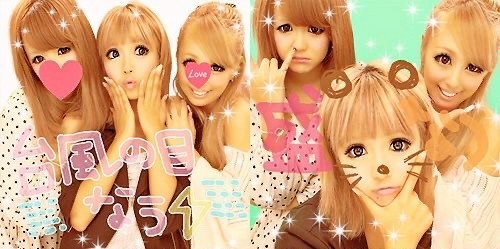
There was an intimacy to the whole thing that is difficult to recover from the stickers alone. Taking purikura came with its own little social order: who was good at rakugaki (doodling), who could be trusted not to ruin a picture, which machine everyone had collectively decided was the good one and, finally, the serious negotiations over who got which stickers. The best went into puricho, notebooks thick with school uniforms, crushes, handwriting and private jokes; others migrated onto flip phones, pencil cases and mirrors. Long before follower lists made relationships publicly countable, purikura had made friendship something you could collect, display and quite literally give away.
When Atlus and Sega released the original Print Club in 1995, it was essentially just a photo booth that printed stickers. By 1997, roughly 22,000 machines had shipped, and what followed was a remarkably efficient feedback loop between an industry trying to anticipate teenage girls and teenage girls discovering increasingly elaborate things they might like a machine to do to their faces. Manufacturers became unusually systematic about studying their tastes, and the results can be read chronologically across the faces the machines produced.
Decoration gave way to beautification; machines promised lighter skin, larger eyes, smaller faces and slimmer bodies, while the late-2000s dekame boom enlarged eyes to proportions that abandoned human anatomy. Then came “natural.” By 2011, FuRyu’s Lady by Tokyo was replacing obvious distortion with light, shadow and increasingly subtle correction, and as smartphones and beauty apps made edited photographs ordinary, purikura became more sophisticated at making its own intervention disappear. Natural, crucially, didn’t mean doing less to the face; it meant becoming better at concealing what had been done.
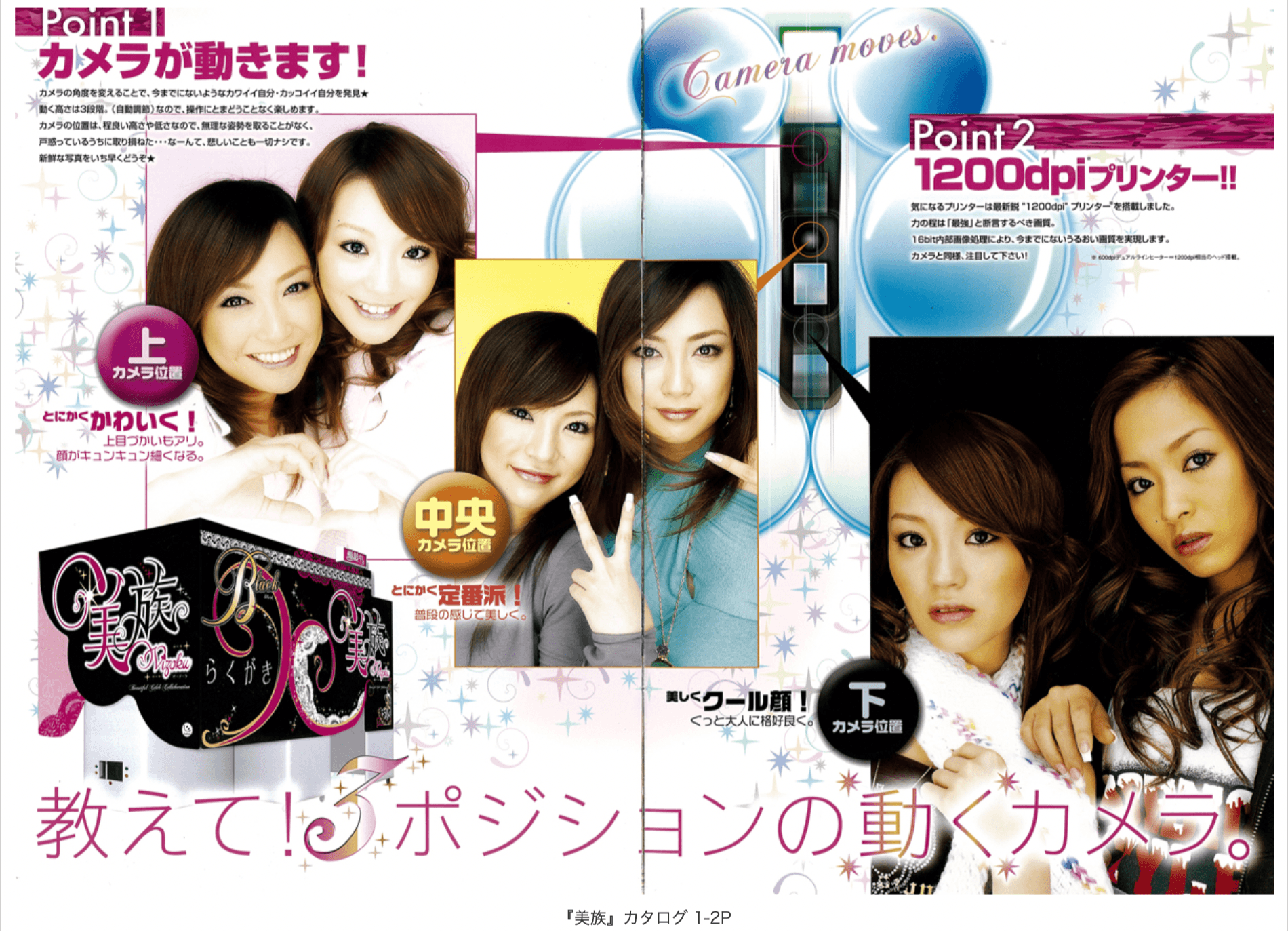
<Image: FuRyu Archive, 美族 BIZOKU. 2005>

<Image: SEGA Japan, GIMMI. 2024>
This is what makes purikura more interesting than the glib observation that Japan got to FaceTune early. Seen across 30 years, purikura becomes an unusually literal record of beauty becoming programmable — and eventually, portable. By the 2010s, the booth was losing its monopoly on the editable face. Beauty apps and social media took what purikura had made a conspicuously communal act and turned it inward, transforming a face made together for an afternoon into one privately maintained over time.
And it was not only the work of beautification that moved inward, but the judgment itself. Purikura made its idea of beauty obvious, imposing the same corrections on everyone, sometimes to comic effect. If your eyes came out enormous or your skin several shades brighter, the machine had done that to you. The smartphone individualized both the labor and the judgment. Instead of simply being handed a prettier face, we were given an expanding menu of corrections and invited to diagnose ourselves. What the machine once imposed from the outside could now feel entirely self-authored: this is simply how I like my face.
There is something almost quaint now about how contained the old transaction was, even though the beauty standards inside it were anything but. Purikura’s history is a fairly unforgiving catalogue of what girls have been encouraged to improve about themselves, from skin tone and face size to eyes, legs and bodily proportions. That we enthusiastically participated in all of this hardly makes those preferences culturally innocent; desire does not become autonomous simply because it feels like your own. But any neat critique of purikura runs into the inconvenient fact that, while all this was happening to our faces, we were having so much fun.
That contradiction feels less contradictory if you’ve ever been a girl around other girls, because femininity has always contained the peculiar experience of learning to look at yourself from the outside while doing much of that looking together. Someone smooths down your hair before a picture, tells you when your makeup has smudged and vetoes the photograph in which you look beautiful because she doesn’t. Purikura took that familiar way of looking at ourselves somewhere much further. It taught generations of us to inspect our faces with extraordinary precision, certainly, but it also made that inspection collective, playful and occasionally tender. The standards were no less restrictive for the intimacy they produced, nor was the intimacy any less real. And still, we leaned over the same screen and told one another, with complete sincerity, no, this one, we look so cute.
LATEST


