Martina Forasiepi
I Saw The Future of Asian Fashion, And It Looked Bright
Rakuten Tokyo Fashion Week was all about balancing roots and routes, past and future, while exploring each individual's creativity.
Every Tokyo Fashion Week carries a message, a subtext that sets the fashion appointments apart from those of any other fashion capital in the world. This season, the Japan Fashion Week Organisation built its Spring/Summer 2027 edition, staged from August 31 to September 5, around a mission statement: honour two decades of history while building the next twenty years. What that meant in practice was a week-long meditation on where a designer's identity actually lives, between history and personal development, and what that means for Japan’s fashion role.
Fashion traditions meet future’s lighthearted promises
Everything connected with Japanese fashion is historically and culturally meaningful and looked up to by all fashion cities. Therefore, expectations are always pretty high. For its Spring-Summer 2027 collection, “Mermaid’s Tears”, Yushokobayashi brought the marine fantasy world to the runway, dressing models in fishnet tops covered in tangling charms. An indie band performing live rock with ethereal vocals replaced the usual soundtrack, completing an environment built for total immersion underwater. Japanese fashion heritage was there, though: from drawn-like brooches to distressed knitwear, and worn-out layering with lace and pearls. The same Rei Kawakubo embraced (the brand actually painted some accessories for the last COMME DES GARÇONS GIRL Fall-Winter collection).

Yushokobayashi SS2027 collection.
https://yushokobayashi.com/27ss.html
Keiko Nishiyama also relied on playfulness to stage her first in-person show. Inspired by the ways nature has been transformed by human intervention, the brand creates imaginary flora and fauna as original textile designs. The Spring-Summer 2027 collection, “Cultivating Wonder”, valued Japanese craftsmanship, materials, and production techniques through orchid-shaped bomber jackets, petal-resembling silk gauze and feminine silhouettes, delicate as flowers.
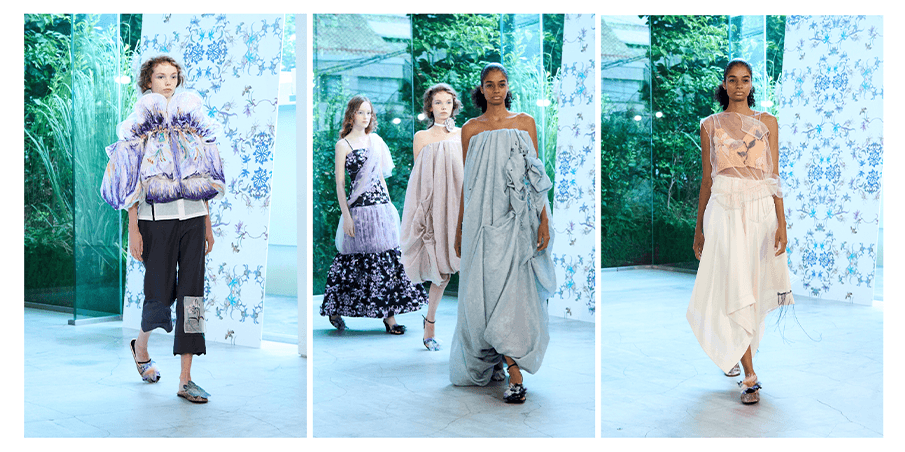
Keiko Nishiyama SS2027
https://rakutenfashionweektokyo.com/en/brands/detail/keiko-nishiyama/
Apparently, both Yushokobayashi and Nishiyama kept one hand on the traditional techniques that got them there (between trompe l’oeil effect and textile craftsmanship), while imagining fantasy worlds and hybrid creatures.
Stripping Down to Something New
Someone just decided to bring something different to the table, leaning into deconstructions, an unspoken private culture and a hint to animation to reimagine a future still tied with the past. Mitsuru Okazaki built the tension between busy city life (evoked by the city noises in the background) and the calm found only in nature (hinted by the birds’ chirping towards the end of the show). Collars were multiplied in some pieces and removed entirely in others (recalling Rei Kawakubo’s works); a closing dress constructed from floating panels looked less like clothing than a form still assembling itself, drawing inspiration from Japanese traditional deconstruction.
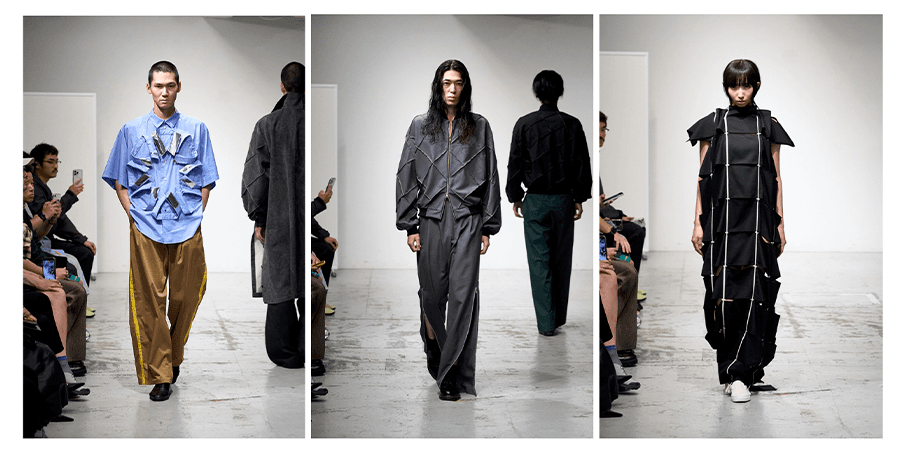
Mitsuru Okazaki SS2027
https://rakutenfashionweektokyo.com/en/brands/detail/mitsuru-okazaki/
Directed by Tzu Chin Shen, Seivson is a Taiwanese brand that builds collections through storytelling and perspectives across gender, culture, and borders. In Tokyo, it staged its “Boudoir” collection (the French word for a woman's private bedroom, dressing room, or sitting room): with few guests and deconstruction, it presented the most intimate parts of girlhood. Architectural corsets, distressed tops, feminine sheer fabrics, reworked Juicy Couture classic velvet tracksuits, lace and tassels that reminded of tapestry decor. Models applying lipstick in front of a mirror and the bored walk created the eerie hush of that intimate room with a sense of something private (and sexy?) being exposed.
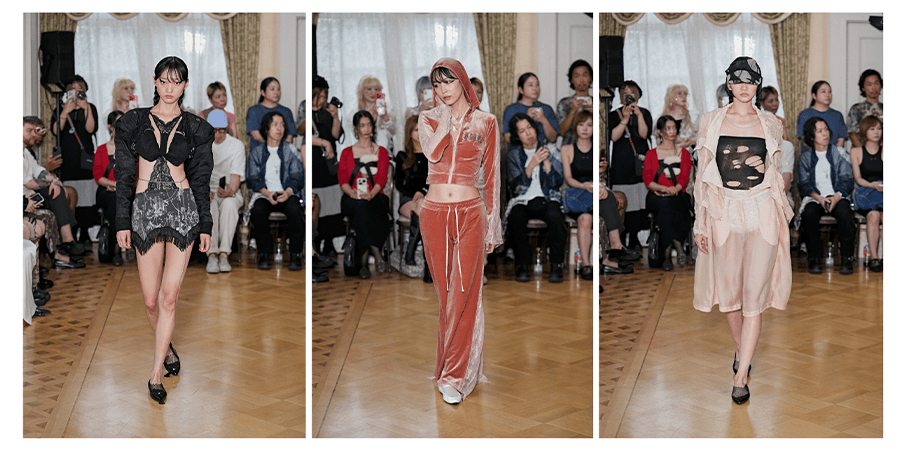
Seivson SS2027
https://rakutenfashionweektokyo.com/en/brands/detail/seivson/
Becoming something new took a more theatrical meaning for Yukihero Pro-Wrestling. Designer Yukihiro Teshima built the brand around a lifelong love of professional wrestling: this season he staged his show with retired fighters walked the runway, alongside the brand's wrestling-inspired designs, collapsing the distance between costume and reality until the clothes themselves seemed to confer the identity of “hero” on whoever wore them. The designs were colorful, featuring mixed prints and irreverent suits. It's impossible not to think of the Japanese anime tradition, with models walking the stage like Kinnikuman’s characters.
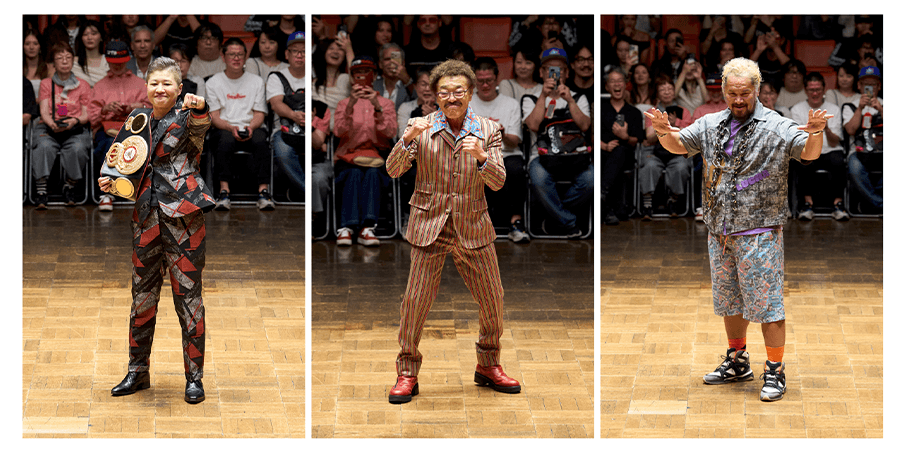
Yukihero Pro-Wrestling SS2027
https://rakutenfashionweektokyo.com/en/brands/detail/yukihero-pro-wrestling/
The good old minimalism
Not every collection needed spectacle to make its case. Someone stayed close to home instead, proving that roots alone, dressed with just enough invention, can be its own kind of route forward. Whitenook, designed by Elmo Su, presented a wearable ready-to-sell collection in fabrics such as linen, cotton, and denim. He took the classic shapes that characterise asian fashion (asymmetrical closures, buttons, fluid tailoring, barrel trousers), dyed in minimal shades of black, white, blue and brown.
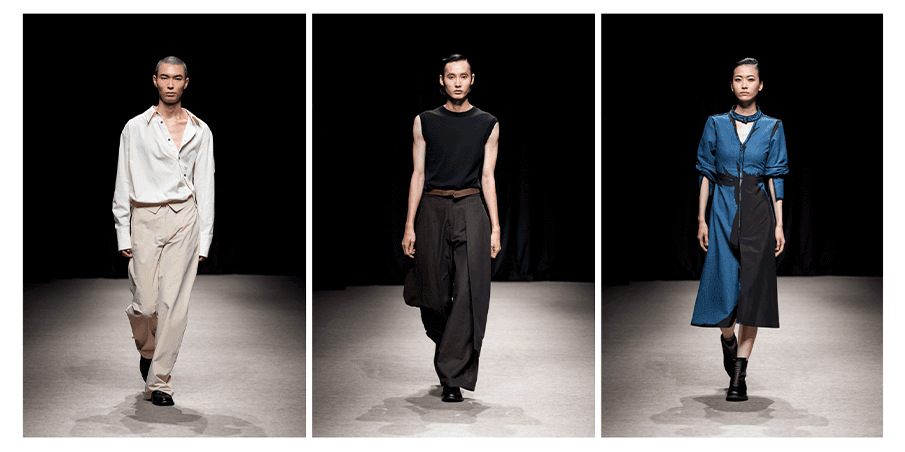
WHiTENOOK SS2027
https://rakutenfashionweektokyo.com/en/brands/detail/whitenook/
Haute Mode Hirata, the milliner's house now carried by Ohko, Saki, and Show Hirata, let its hats add an avant-garde touch to minimalism: oversize flower on hats mixed with leather jackets, oversize baseball hats on casualwear (classic shirts layering on pinstriped sartorial trousers), and a simple black dress turned into occasionwear under a red, flower-embellished baseball cap. Extravagant accessories with the power to determine who we are and when, brought to life by generational craftsmanship.
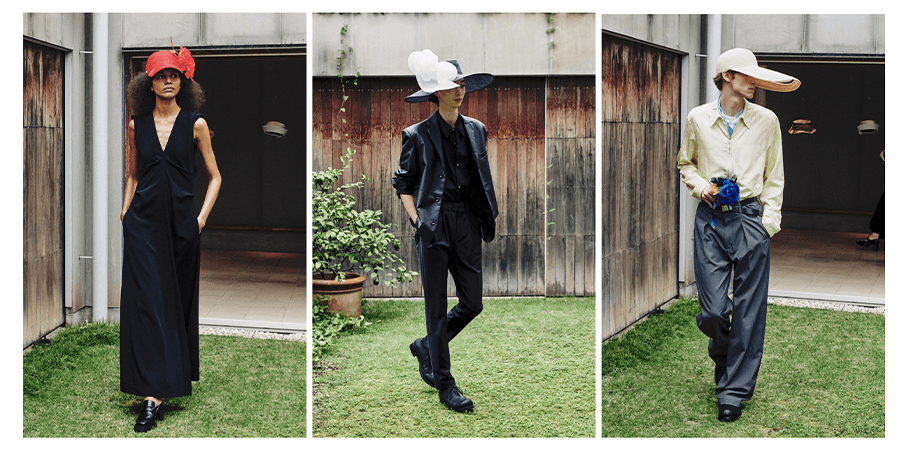
Haute Mode Hirata SS2027
https://rakutenfashionweektokyo.com/en/brands/detail/haute-mode-hirata/
None of these houses shared a coordinated theme. But the meaning of all collections together was hard to miss by the end of the week. Whether exploring maximalist aesthetics, fantasy worlds, recollecting silhouettes and techniques from the past, or adding the avant-garde to the minimalist, this season was all about roots and routes. Between Paris’s historic houses and New York’s commercial approach, Tokyo has always covered a particular niche in the global fashion calendar, a place where independent designers could develop ideas on their own terms. A brand founded in 1955 tried to answer the same question as a house that debuted for the first time: how do you stay legible and recognisable while everything around you changes, while keeping your history intact? As of now, heritage and horizons in Asian fashion are the same engine nourishing an unprecedented, differentiated creative force, rather than opposing forces.
Cover image courtesy of Jake Cheff @jakechefffffilm
LATEST