Martina Forasiepi
The Whimsy Turn: Why the West Wants to Feel Kawaii
For western girls and boys, being whimsical and cute is apparently the highest 2026 ambition. But what if the origin behind it is way more established than just a trend? Like fifty years of rebellion, contested history, and design theory?
Over the past two years, and especially this year, the world has become pretty familiar with the word “whimsical”: it may mean wearing pink bows or pastel eyeshadows, walking barefoot in floral fields, hanging a Labubu monster from a designer bag, or collecting shells on the beach. And right now, different industries across different continents are adopting the same emotional register: a mix of softness, playfulness, and a curated innocence that demands to be listened to and protected. Call it whimsical core, call it the coquette revival, call it kawaii (the Japanese term for “cute”): the labels multiply faster than anyone can standardise them, which is itself a clue that something larger is moving underneath the surface. Unusually for an aesthetic trend, this one now has its own academic subfield dedicated to working out why.
The Cute Studies
Nowadays’ form has a precise birthday: in her essay Cuties in Japan, the sociologist Sharon Kinsella traces it to 1974, when large numbers of Japanese teenagers, mostly girls, began writing in a new, rounded, laterally-slanted script nicknamed koneko-ji (“kitten writing”) or marui-ji (“round writing”), which broke with the conventions of traditional Japanese calligraphy. It then spread with startling speed: by 1978 it was a nationwide phenomenon, and by the mid-1980s researcher Yamane Kazuma's surveys found that over half of Japanese female high schoolers were using it, with schools banning it or refusing to grade tests written in it.
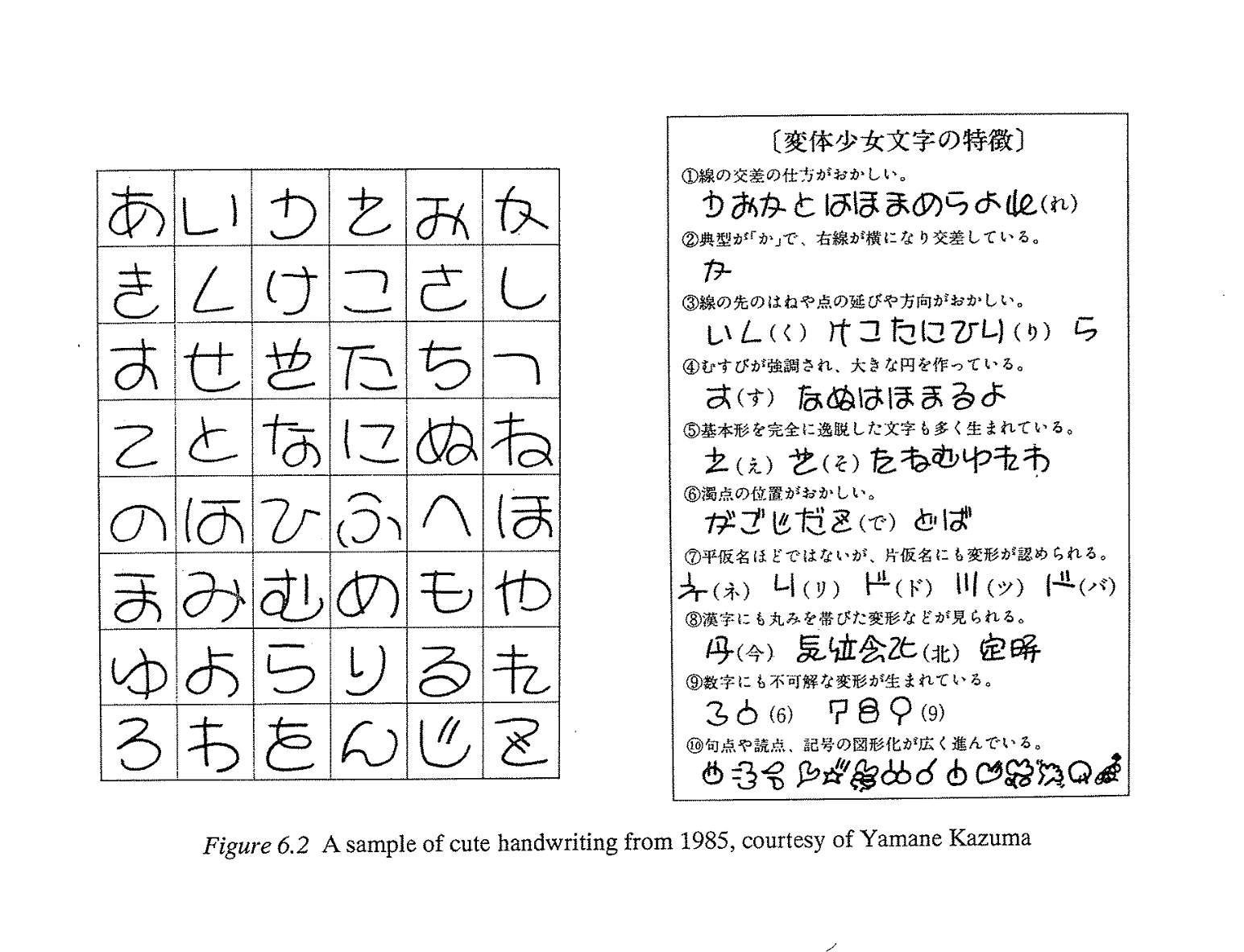
A sample of cute handwriting from 1985, taken from Cuties in Japan (1995) by Sharon Kinsella.
As it normally happens, business followed the kids. In 1971, Sanrio began printing cute character designs on writing paper and diaries aimed at the same schoolgirls hooked on the new handwriting craze. It worked spectacularly: by 1990, Sanrio alone was moving roughly ¥200 billion a year in “fancy goods”, within an industry Kinsella estimates was worth ¥10 trillion in Japan that year. The company built an entire cast of proprietary characters (Hello Kitty chief among them) whose licensed images ended up on the credit cards of Japanese banks, the packaging of insurance companies, even municipal road-construction barriers. Basically, the aesthetic scenario still associated with Japan. The formula for a cute character, per Kinsella's analysis, was consistent: small, soft, round, without visible bodily orifices or working limbs, mute, and helpless.
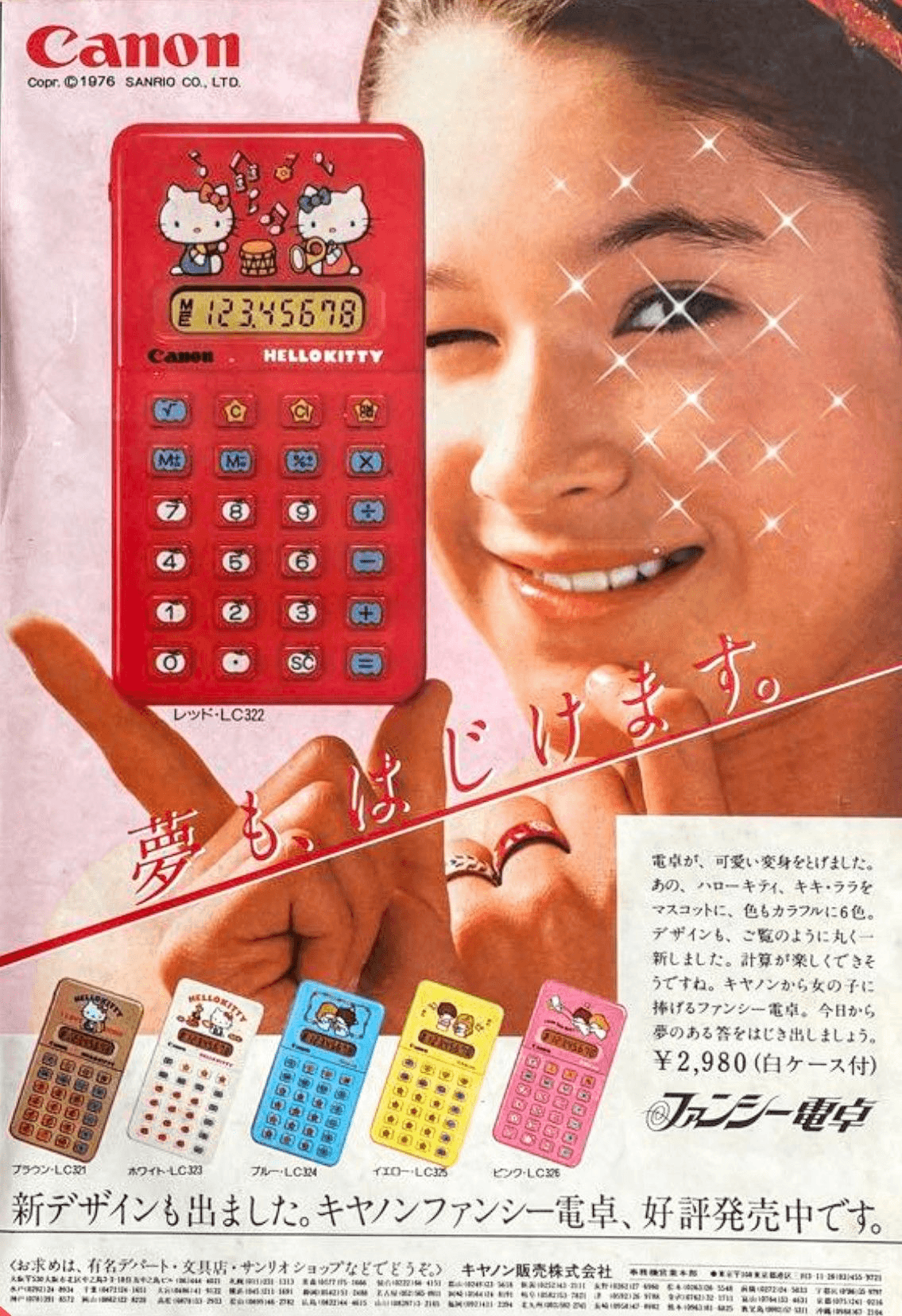
1976 Sanrio’s advertisement for school calculators.
Link:https: //pin.it/3k0LP91Kz
Joshua Paul Dale, who contributed to formalise Cute Studies as a field, frames the caregiver response towards such childish characters as one of its two foundational pillars: an affective register (the involuntary “aww” reflex) and cuteness as a manipulable aesthetic category that designers, marketers, and now meditation researchers can deliberately deploy. Other studies, such as those conducted by the psychologist Hiroshi Nittono, explore the behavioural response to being exposed to cuteness. So, no, it’s not just lace and frills.
The West and the softness
What's happening outside Japan in 2026 is a remixed kawaii transposition with its own regional accent. The adoption of this whimsical behaviour moves through fashion (like the proliferation of the jelly shoe trend), make-up (such as glitters, pastel colours, unexpected eyeliner shapes), anti-brainrot apps and websites (such as Good Pizza, Great Pizza, a mobile game where you run a tiny, aesthetic pizza shop full of eccentric customers; or duckstreet.net, an idle pixel art game where skateboarding ducks parade with different accessories).

Mobile game Good Pizza, Great Pizza, via Google Play.
However, according to Cute Studies, it is difficult to perceive Western attraction as mere aesthetic preference. Firstly, because of the meaning of cuteness outside of stationery and toys. Kinsella's fieldwork in 1980s and '90s Japan found that young people, especially young women, used cute style as a deliberate refusal to grow up and escape the responsibilities of adulthood, which her respondents overwhelmingly described as a period of harshness, obligation, and lost autonomy. Critics at the time read the same behaviour as straightforward infantilization: in his book, the artist Takashi Murakami, went further, arguing that Japan's whole postwar kawaii economy sublimated the national humiliation of military defeat and American occupation into an aesthetic of being «pampered children». Whether you read 1980s kawaii as resistance or as regression depends on whose account you trust, but scholarship has tended to consider it a source of agency and even soft rebellion for people.
The second complication shows up specifically in the United States, a country with its own, very different racial history. In the article published for American Quarterly in 2019, Leslie Bow described it as “racist cute”. Her example regards some specific objects (a Chinese-takeout-box-shaped handbag, Alessi’s conical citrus juicer, a smiling emperor-shaped kitchen timer). Strip away the cute styling, she argues, and these objects use the same visual shorthand as older, openly racist caricatures of Asian people: slanted eyes, exaggerated smallness, a blank, doll-like face. The only thing that's changed is the emotional wrapper, since cuteness reads as affection, and not mockery. According to the same article, part of why kawaii travels so easily in the first place is a deliberate design strategy called mukokuseki, «the erasure of racial, ethnic, or cultural resonance» from Hello Kitty and Pikachu so they can be adopted anywhere.
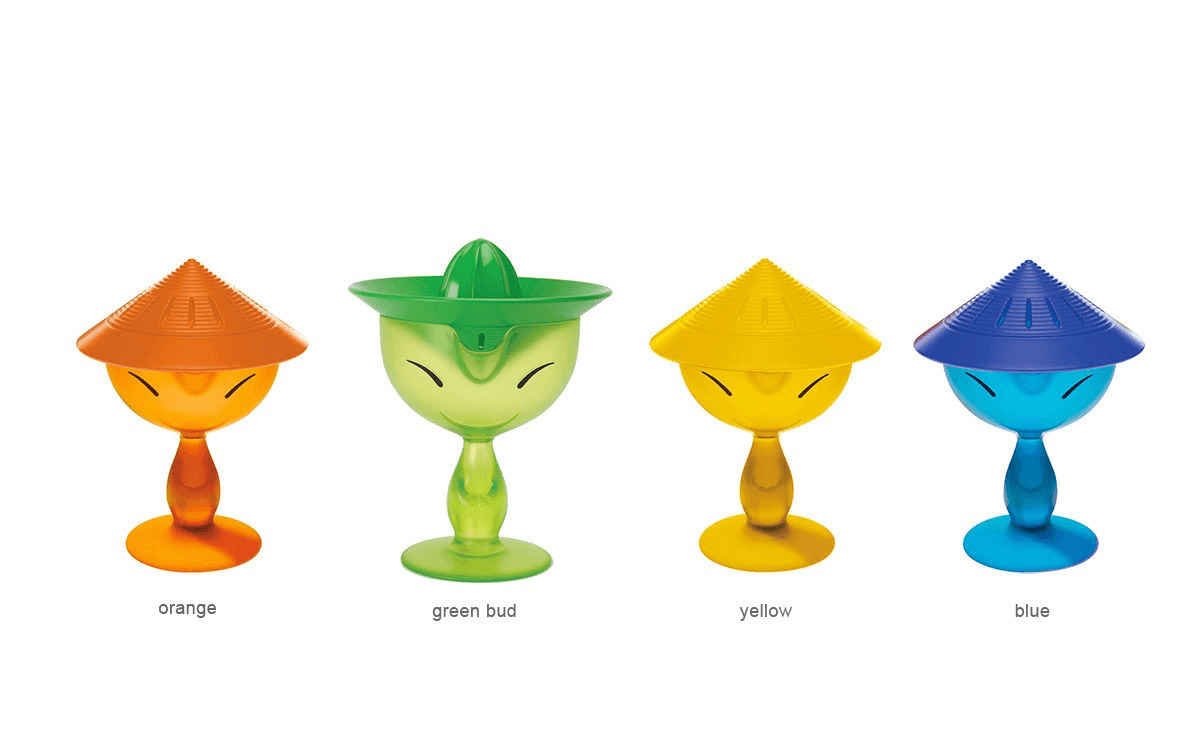
Mandarin Citrus-squeezer, Alessi, Italy.
Link: https://share.google/WTRVHzCfOEHGskGfP
Of course, that doesn't mean every cute Asian-inspired object carries this weight, and Bow herself notes that audiences in Japan and across the Asian diaspora often see the same objects as sincere homage rather than caricature.
From rebellion to remedy
If cute started as an underground teenage dialect and grew into a multi-billion-dollar industry, its most recent turn is stranger still. In Development of the “Cute” Meditation (2025), Yoshihiro Kanai collects the results of the past several years developing and testing “kawaii meditation”, a clinical adaptation of loving-kindness meditation in which participants direct compassion toward photographs of human and animal infants rather than toward difficult people, on the theory that cute images reliably evoke a caretaking, oxytocin-linked warmth that's far easier to access than compassion for oneself or a stranger. Early controlled studies suggest the practice measurably reduces confusion and, in some populations, social-anxiety avoidance.
https://www.instagram.com/reels/DaArr7GuUye/
Creator Zoë Nobileau on cute meditation
It's a fitting endpoint for a fifty-year arc. What began as an illegible handwriting style has become, passing through Sanrio's empire and fashion microtrends, a recommended therapy. The world's current appetite for whimsical softness in coquette bows and Labubu figurines draws on the same well: a set of visual triggers that turn out to be one of the most reliable emotional shortcuts human beings have found to escape the nihilism and crisis of the present.
LATEST

