Martina Forasiepi
Why Western Music Videos Keep Reaching for Japanese Cinema
Romain Gavras' new short for Gener8ion and Yung Lean is the latest entry in a three-decade habit: Western directors borrowing a Japanese visual grammar their own tradition never built.
Close your eyes and picture four schoolboys standing on the edge of a rooftop, their hands on the balcony railing to prevent them from falling to the ground. Imagine them playing a fearless game against fate, clapping their hand three times quickly, just before falling. Imagine their smirk and their daring expressions. Released on April 24th, Storm has been cut in half for months by the internet, which lined Romain Gavras' new two-part short for Gener8ion up frame-by-frame against Toshiaki Toyoda's Blue Spring (Aoi Haru, 2001). Same rooftop games, same collapsed hierarchy in a school with no adults left standing, same concrete-and-cherry-blossom mood of boredom (swapped, in the Western version, by British green hills) curdling into violence. TikTok didn't have to dig for the reference, as Gavras had already named Toyoda's cult movie alongside the video game Bully as touchstones while discussing the project.
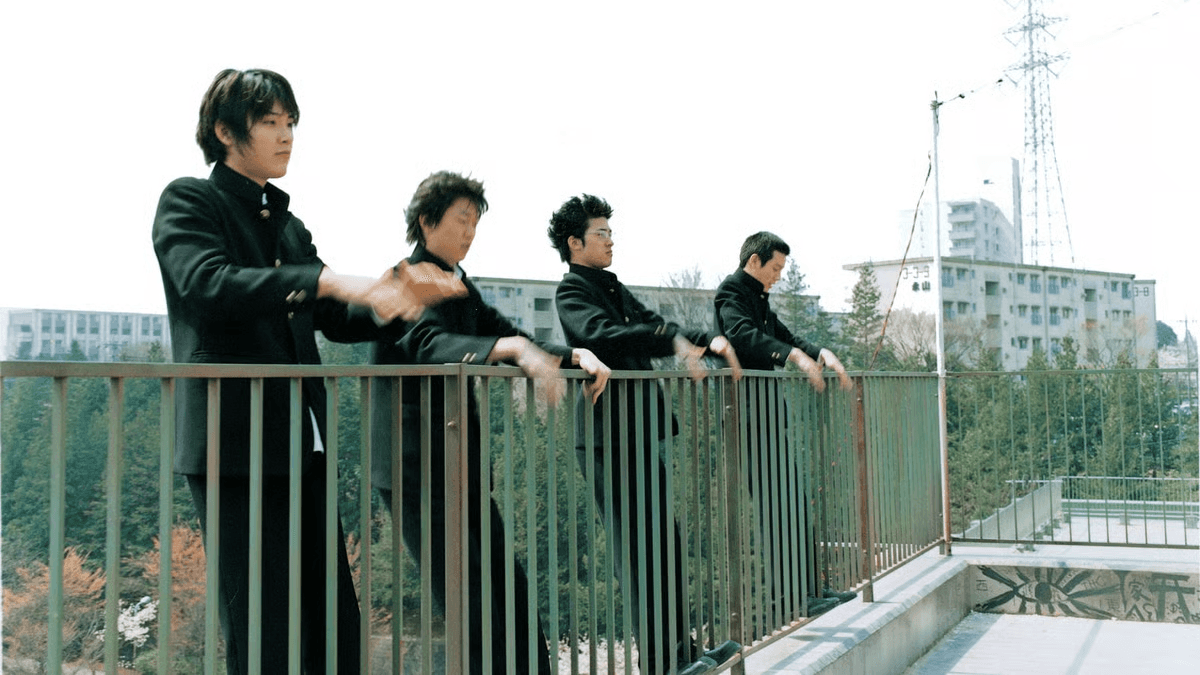
Aoi Haru, 2001. Image source: https://www.filmlinc.org/films/blue-spring/
Set in an all-boys school in 2034 Leeds with no teachers in sight and every room doubling as a smoking area, Storm stars Swedish rapper Yung Lean as a magnetic ringleader, with choreography by Damien Jalet turning a school photo into a feral, synchronised dance. Before shooting, Yung Lean’s character was pitched as «a drunk hooligan singing an ABBA song»: a description that lands much closer to Toyoda's bored, half-feral schoolboys than to any British or American campus-movie archetype. Somehow, Western directors and artists periodically climb inside Japanese cinema and rebuild it as their own. Hype Williams took Kanye West to Tokyo for the 2007 Stronger video to recreate the entire sequences from 1988 Katsuhiro Otomo's Akira almost shot-for-shot (the hospital gurney, the psychic breakdown, the riot). Williams later confirmed the source plainly: «He was always inspired by Akira.» West has kept saying so ever since, once naming Akira his «biggest creative inspiration» over Twitter.
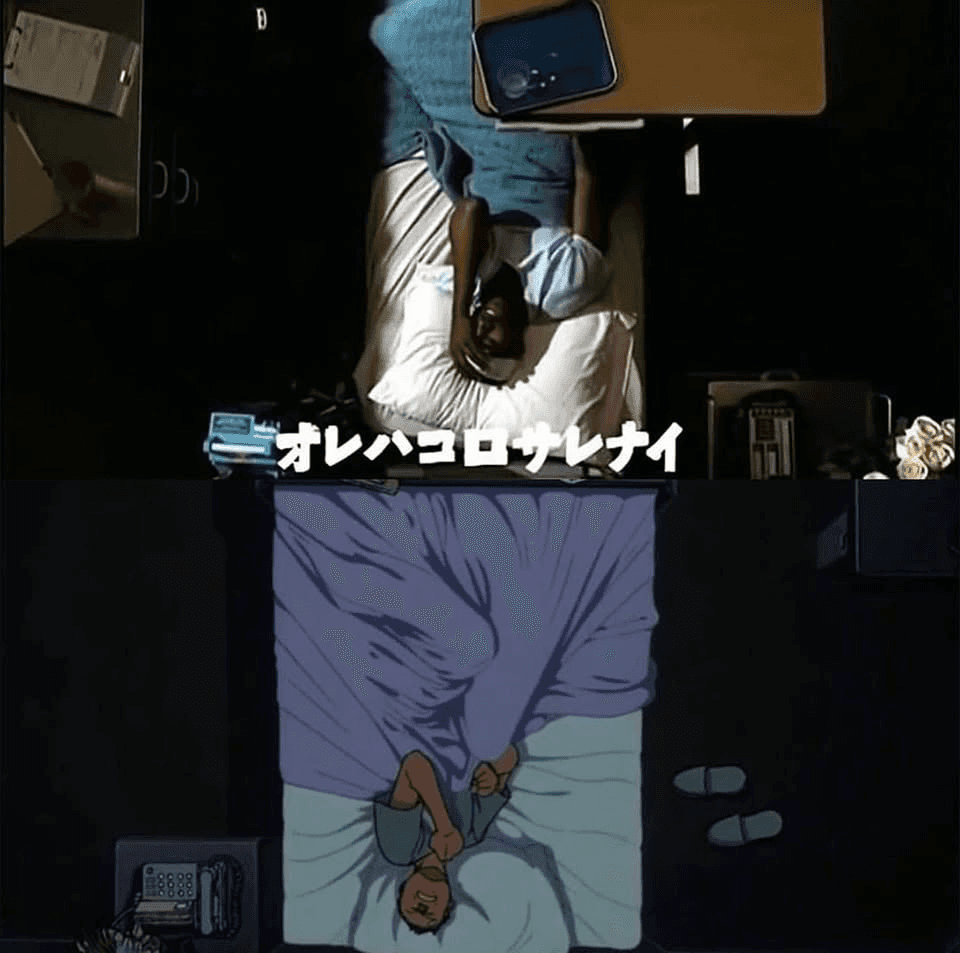
Stronger music video. Akira (1988). Image source: https://www.facebook.com/geekofnerd/posts/kanye-west-stronger-akira-1988instagramcomgeekofnerd/1006109708209754/
Daft Punk went even further, handing their 2001 album Discovery over to Galaxy Express 999 creator Leiji Matsumoto and letting him direct Interstella 5555: The 5tory of the 5ecret 5tar 5ystem, a feature-length anime built around the music, rather than illustrating it after. Released in May 2003, the movie tells the story of the abduction of an alien music band by an evil human character who has dark plans. It was then cut into music videos to accompany Daft Punk’s album Discovery, and rarely screens today in its original feature form. Damon Albarn and Jamie Hewlett also built an entire band, Gorillaz, on the same foundation, with Hewlett citing Studio Ghibli and Akira as formative touchstones for the project's tone and look.

Discovery Gold Vinyl (Interstella 5555 Edition) Image source: https://eu-shop.daftpunk.com/it/products/discovery-interstella-5555-edition-gold-vinyl
Considering all these examples, you may wonder why Western artists keep crossing the Japanese borders — or, more specifically, what specific thing they are looking for there. It may seem obvious (and it is), but it’s also still worth-mentioning: Japanese contents differ significantly from Western audiovisual products. Toyoda's Blue Spring isn't really about violence; it's about a very particular flavour of adolescent nihilism, kids testing a hierarchy that's already hollow, boredom as the real antagonist. American and British teen cinema has its own traditions (such as the TV series Skins), but it rarely sits inside meaninglessness without resolving it, as the plot usually revolves around the resolution of the main issue. Japanese youth cinema is usually comfortable with staying still, dwelling and depicting the present moment. Presumably, that's what the register Gavras reached for: he has framed his own version of that discomfort as a kind of romanticism rather than pure bleakness, with beauty and violence sitting in the same frame, the end of the world played as something kids will always find a way to enjoy anyway.
None of this is happening from nothing, either. The last two years have seen a broader wave of Japan-mania in the Western press: a weak yen has made Tokyo cheaper to visit than it's been in decades, and tourist arrivals hit a record 42.7 million in 2025, up nearly 16% on the previous year and a third higher than the pre-pandemic peak. Japan has simply never been this present in the Western cultural bloodstream, and artists reaching for its cinema now are reaching into a country that, for once, everyone else is reaching for too.
It has also to be noted that Japan spent most of the 20th century absorbing American cinema, television, and music, and transforming it into something recognisably its own; what's happening now is Western artists going back to the place that already metabolised their own tradition once, and finding it changed into something they don't have a domestic version of. It's an ongoing exchange of images and visual experience that keeps feeding both directions — which is probably why the Blue Spring comparisons attached themselves to Storm so fast, and why nobody involved seemed bothered by it.
LATEST