Wakaba Oto
Vaughan Allison of MiaMia Rethinks the Tokyo Coffee Model
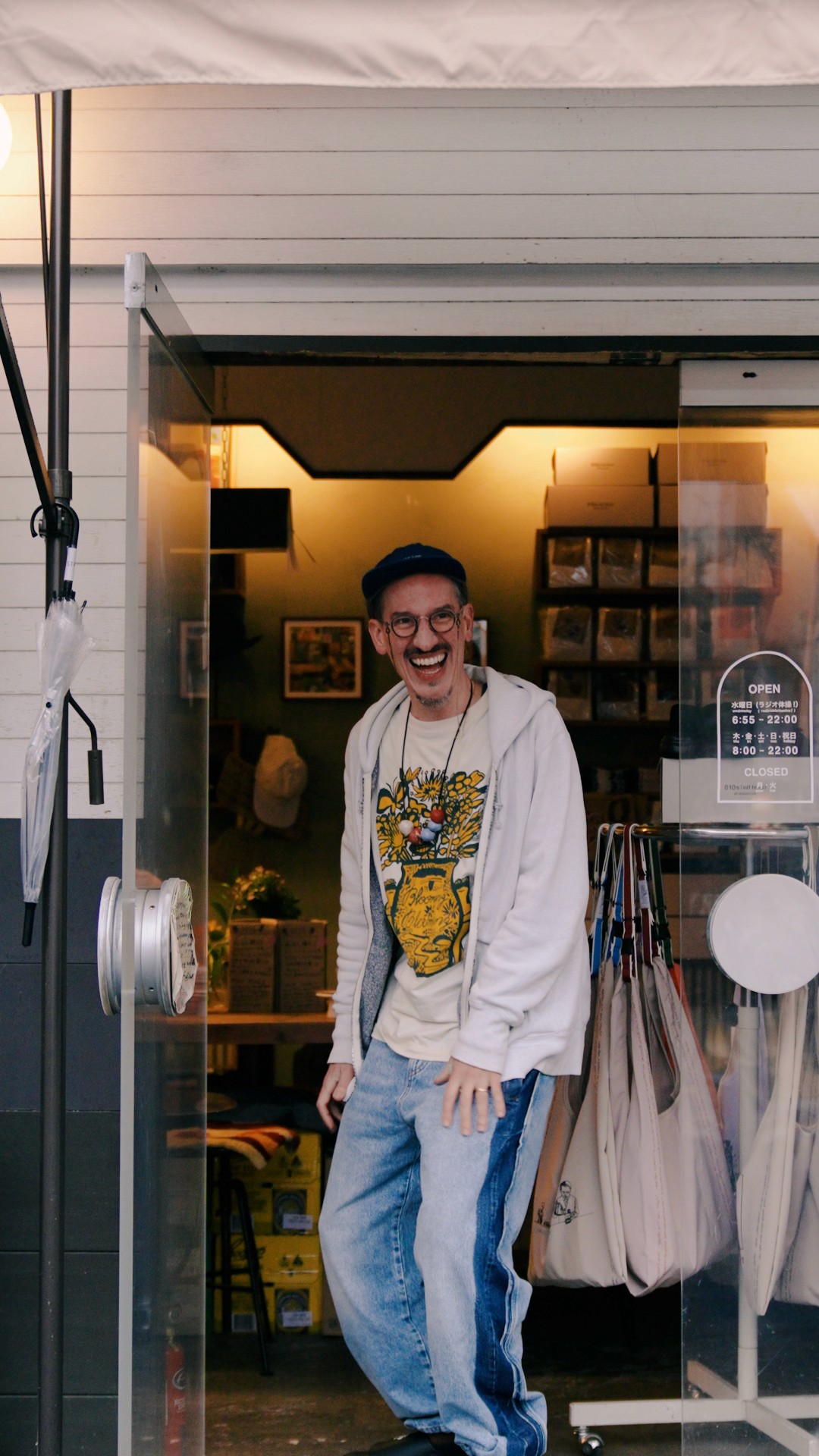
At MiaMia in Higashi-Nagasaki, owner Vaughan is rethinking what a neighborhood coffee shop can do.
At 6:55 a.m. in Higashi-Nagasaki, the neighborhood is still half-asleep. Trains hum past on the Seibu Ikebukuro Line. Shop shutters remain closed. A few locals walk with the particular purpose of early mornings.
But inside MiaMia Tokyo, the lights are already on.
Owner Vaughan Allison notices the details first: the rain, the time, the fact that someone woke up at five — or maybe four — just to be here. This is what he thinks about when the door opens.
“I want to genuinely say thank you for waking up,” he says. “That’s it.”
MiaMia is a coffee shop. It serves carefully sourced beans from Japan and Australia — including Fuglen and a collaborative blend with the long-established Tokyo kissaten Chatei Hatou — alongside third-wave coffee and a small selection of baked goods, from canelés and ice cream sandwiches to vegemite sandwiches, a nod to his Australian roots. It sits quietly in Higashi-Nagasaki, a residential neighborhood that has been slowly transforming into a pocket of independent cafés and shops.
But describing MiaMia as just a coffee shop misses the point. Vaughan himself struggles to define it cleanly.
“It’s a coffee shop,” he says, then pauses. “But it’s not only a coffee shop.”
What happens here begins with coffee, but it doesn’t end there. People greet each other. Conversations start. Someone asks a question they didn’t expect to ask. Something small — but meaningful — begins.
Where It Started
Vaughan grew up in Melbourne, where his family ran a theater restaurant — an unusual hybrid of dining and live performance. On weekends, around 200 people would gather for dinner, singing, dancing, comedy, magic. But the heart of the place wasn’t the show. It was his mother.
Before performances began, she visited every table.
“She would say hello, thank them for coming,” Vaughan recalls. “And in three minutes, she’d get their story.”
Birthdays. Anniversaries. How a couple met. Why someone had moved cities. What they were planning next. She remembered them all. Then, during the show, she would introduce people to one another, turning strangers into participants, spectators into a shared room.
At the end of the night, people didn’t leave right away. They drifted toward other tables. They talked. They lingered.
“That was normal for me growing up,” Vaughan says. “Meeting new people, but not feeling like it was the first time.”
This was Vaughan’s baseline: a world where stories were exchanged freely, where acknowledgment mattered, where being seen was part of hospitality. That early exposure still shapes how he thinks about space.
The Heart of MiaMia
Vaughan came to Japan after years of studying Japanese, encouraged by a teacher to apply to university here. A scholarship made it possible. He stayed four years, then longer. More than two decades later, his relationship to the country is not defined by novelty, but by accumulation.
Before opening MiaMia, he visited more than 2,000 coffee shops across Japan. Kissaten. Small independents. Modern specialty shops. Chains. He wasn’t looking for inspiration so much as patterns — how people moved, how long they stayed, what the space asked of them.
What stood out most was contrast.
Japan’s coffee shop culture is deeply rooted, particularly through kissaten, which privilege slowness and atmosphere. Coffee as pause. A reason to sit, to rest. At the same time, modern Tokyo is dominated by chains built around efficiency and transactional clarity. You order. You receive. You move on.
“You can live your whole day without speaking to anyone,” Vaughan says. “And everything still works.”
He doesn’t frame this as a failure. Japan, he says, is extraordinarily convenient. You can move through the city with near-frictionless efficiency: trains arrive on time, payments are contactless, and daily life functions smoothly.
And yet.
“I meet a lot of people,” he says. “Some are doing great. They’re motivated, successful, working hard. But there’s still something missing.”
Even in one of the most densely populated cities in the world, isolation is common. People are surrounded, but alone. Respect for privacy — one of Japan’s great cultural strengths — can also make it difficult to ask for help, or even to admit loneliness.
MiaMia did not emerge as a correction to this condition, but as an alternative pace.
The shop does not have a service manual. Staff aren’t trained to follow scripts. Vaughan is wary of hospitality that becomes purely procedural — technically flawless, emotionally neutral.
“A neighborhood coffee shop doesn’t need to be like a department store,” he says.
Instead, MiaMia operates on looser expectations. Baristas speak naturally. Regulars are acknowledged without ceremony. New customers are greeted, but not managed. Conversations begin between staff and customers and sometimes expand outward, without direction. The space allows for overlap.
That logic didn’t stop at the original shop.
After six years, Vaughan opened a second location in Kuramae, housed in a renovated 120-year-old former rice shop. The ground floor is a coffee shop. The upper floors are lodging. Travelers from overseas stay alongside visitors from outside Tokyo. Locals gather below. The result is a quiet collision: people passing through the city meet those who live in it. Stories cross.
Outside the Coffee Shop
Outside his coffee shop, Vaughan’s working life follows a similarly uncontained shape.
Running MiaMia is only part of it. He has taught English for 15 years, models commercially, and previously worked as a music promoter and artist manager. Music remains a constant.
A few times a year, MiaMia hosts live performances, bringing musicians into the space and gathering customers and staff together. Most of the proceeds go directly back to the artists. Vaughan describes these events not as programming, but as rebalancing.
“Artists give people energy,” he says. “You feel it for a long time after.”
This refusal to separate livelihood from interest — to silo work from care — defines Vaughan’s approach more than any single philosophy.
A Daily Practice
On Wednesday mornings, MiaMia opens early for rajio-taiso — or radio calisthenics, the familiar calisthenics many people remember from school days and public parks, where it’s often led by older neighbors or played over tinny speakers during field days and local events. The movements are simple and slightly awkward — arms swinging wide, bodies moving in near-unison, some participants more committed than others. Locals gather, stretch together, then leave.
MiaMia does not position itself as an answer to urban loneliness, nor does it attempt to formalize community. It offers something simpler: a place that acknowledges presence, allows time, and does not rush interaction to conclusion.
And in a city optimized for movement, that refusal quietly reshapes the space around it.
LATEST