Alyssa Samuel
Inside The World of NANA
With punk aesthetics, volatile friendships, and the loneliness of early adulthood, Ai Yazawa’s NANA redefined shojo manga through emotional realism that still resonates decades later.
The Sex Pistols, Vivienne Westwood, and the chaos of band relationships — Ai Yazawa transformed shojo animanga forever. At a time when the genre leaned heavily into fantasy and idealism, NANA arrived sharp-edged, stylish, and painfully real, turning love, ambition, and heartbreak into something raw enough to live beyond the page.
From a young age, Yazawa immersed herself in manga magazines like Ribon, becoming fascinated by stories outside the polished constraints of traditional shojo. Born in Hyogo Prefecture in 1967, she became deeply influenced by punk music, London fashion culture, and Japan’s growing alternative scene, later channeling those influences into works like Neighborhood Story and Paradise Kiss. Those influences first crystallized in Paradise Kiss, where romance was no longer fantasy, but something fragile, and complicated. By the time NANA began serialization in Cookie magazine in 2000, Yazawa had already developed a reputation for writing women with unusual emotional realism: impulsive, insecure, selfish, and painfully human in ways shojo protagonists rarely were at the time.
Following its 2000 serialization in Cookie, NANA quickly became one of the defining josei/shojo crossover works of the 2000s, eventually selling over 50 million copies worldwide. Its 2006 anime adaptation further cemented its cultural dominance, introducing Yazawa’s world of punk apartments, band rehearsals, and emotional self-destruction to an international audience.
When creating NANA, Yazawa pushed those ideas further. Rather than writing solely for young women, she crafted a story centered on the emotional complexity of female friendship in a way manga rarely had before. Love between friends in NANA is layered and unstable, devoted yet fearful, intimate yet lonely. Every character is flawed, every relationship imperfect, and every emotional wound is left exposed.
That refusal to romanticize people is what made NANA feel revolutionary. Yazawa replaced shojo idealism with something darker and painfully recognizable: the anxiety of growing up. The result was a story that didn’t just redefine shojo manga stylistically, but emotionally, one that continues to resonate because of how honestly it portrays the messiness of growing up, loving others, and losing yourself in the process.
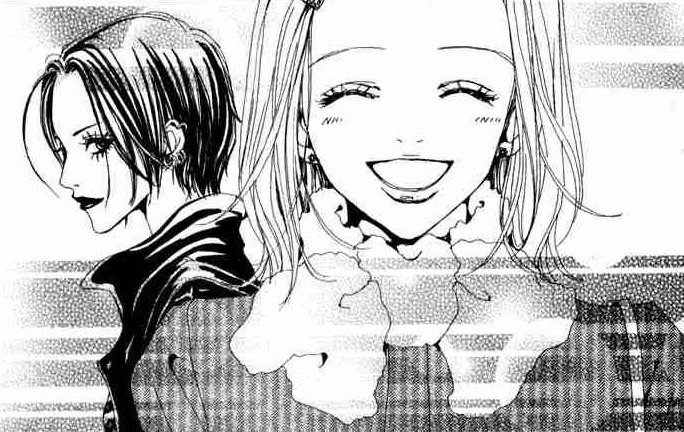
Nana Osaki and Nana Komatsu, better known as Hachi, diverge in almost every way. Yet a chance meeting on a train to Tokyo becomes the catalyst for the karmic entanglement of their lives. Both are emotionally lost, entering uncertain chapters, and bound together by the coincidence of sharing the same name.
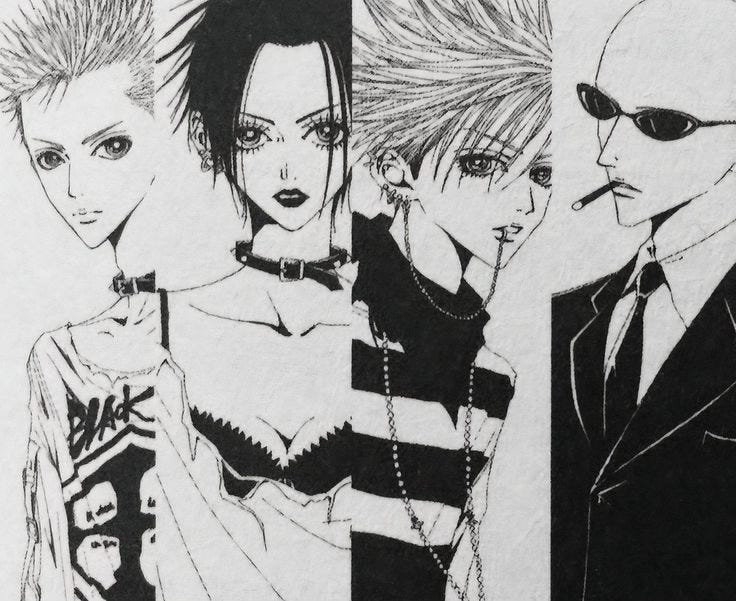
What makes their relationship so compelling is the quiet obsession they develop with one another. Hachi idolizes Nana O completely; her aloofness, recklessness, and effortless cool radiating through every cigarette, and Vivienne Westwood ring wrapped around her fingers. Nana O, however, envies Hachi’s softness, optimism, and ability to love openly. Each woman represents the femininity the other longs for but cannot fully become.
This becomes one of Yazawa’s strongest motifs throughout NANA: the desire to become someone else without fully understanding the emotional cost of living as they do. Their connection is not simply admiration, but projection, dependency, jealousy, devotion, and longing wrapped into one relationship. NANA ultimately becomes the story about emotional orbit: what happens when two people begin shaping their identities around one another so completely that separation becomes almost impossible.
NANA’s devastation begins with the understanding that its emotional weight never exists solely within the friendship between Nana Osaki and Nana Komatsu. As their lives intertwine with Nana O’s band and inner circle, the parallels between them tighten almost suffocatingly, trapping both women within the same emotional patterns despite their different personalities.
Yazawa constantly mirrors their struggles against one another. For Nana O, bitterness stems from ambition and abandonment, particularly from her unresolved jealousy toward her former boyfriend, whose departure from their band led him toward fame elsewhere. Beneath her hardened exterior is the fear of being left behind emotionally and artistically.
For Hachi, that bitterness manifests through love itself. Her past involvement in an affair leaves her terrified of intimacy and repeating her mistakes. Where Nana O fears replacement, Hachi fears dependency and self-destruction. One woman is consumed by success slipping away; the other by the instability of love.
These mirrored anxieties become one of the story’s strongest catalysts. Yazawa uses them to show how resentment, insecurity, and longing evolve differently depending on the life someone leads, yet still arrive at the same isolation. In NANA, success does not heal loneliness, and love does not guarantee safety.
Part of what has allowed NANA to remain culturally defining across decades is how lived-in its world feels. Beyond the Vivienne Westwood jewelry and punk aesthetics, Yazawa captures a very specific version of Tokyo rarely romanticized in shojo manga at the time: cramped apartments, convenience store dinners, live houses, unstable creative careers, and the loneliness of trying to build a life in the city before fully understanding yourself.
At surface level, NANAi can easily be reduced to aesthetics. But its lasting power comes from emotional realism. Relationships in Yazawa’s world are shaped as much by timing, insecurity, and circumstance as they are by love itself. Nothing is simplified into “good” or “bad,” and people do not necessarily grow into better versions of themselves simply because they suffer
Audiences see fragments of themselves in both Nana Osaki and Nana Komatsu through ambition, fear, love, regret, and dependency. Nothing is simplified into “good” or “bad.” Instead, Yazawa insists on emotional ambiguity as the default condition of being human.
Unlike many coming-of-age narratives where characters overcome conflict through clear growth arcs, NANA refuses the comforting fantasy that pain naturally produces maturity. People stall, repeat mistakes, sabotage one another, and remain haunted by earlier versions of themselves. That refusal to grant easy catharsis is precisely what continues to make NANA feel painfully real decades later.
LATEST