Wakaba Oto
Inside Zinchiku Randan, The All-Female Garage-Punk Band Playing Against Comfort
In Shinjuku’s live houses, one all-female punk band plays loud, fast, and without framing.
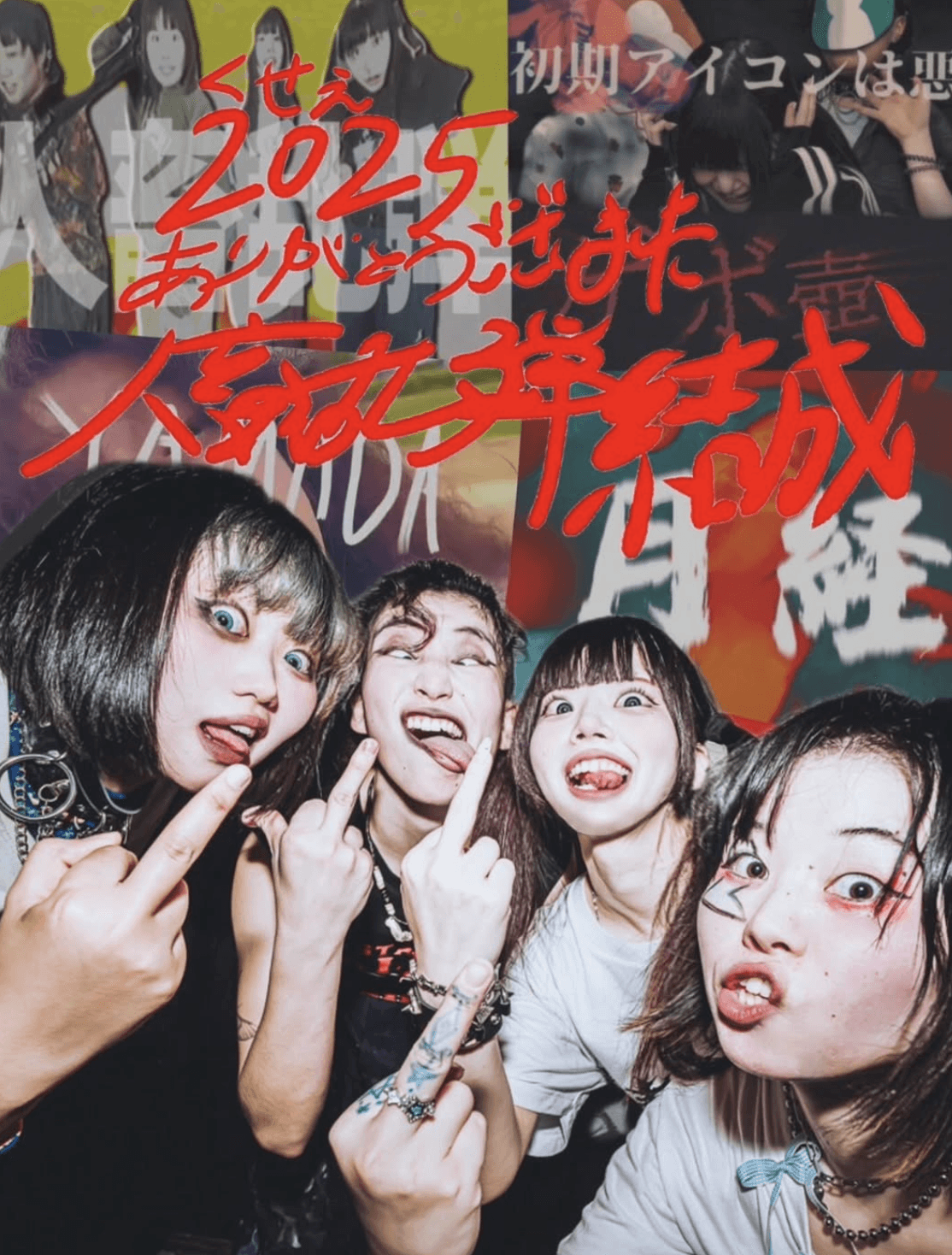
The band introduces itself in the bluntest possible terms: a “stinky woman four-person band”. Formed in early 2025, Jinchiku Randan is a all-female Shinjuku-based punk band made up of Benisuzumetafa (vocals, guitar), Suzuki Nesiology (lead guitar), Shima Tsukue (bass), and Gochiru Wakaba (drums).
On March 1, 2025, the band released a four-track EP titled Naguriaidabutsu. The record runs just over thirteen minutes and is available on Apple Music and other streaming platforms. It is fast, distorted, and minimal — more a document of momentum than a carefully staged debut. Despite being available online, the EP is rarely foregrounded in the band’s live promotion. Shows, not releases, are the primary point of contact.
Jinchiku Randan plays frequently, almost exclusively in Shinjuku. They appear regularly at small live houses such as Shinjuku Marble, a basement venue in Kabukicho that has long hosted punk, hardcore, and noise acts. These venues operate on tight schedules and tighter margins: low ceilings, minimal separation between stage and audience, short changeovers between bands. Sets tend to be brief. Equipment is shared. There is little room for theatricality.
The band’s performances follow that structure closely. They come on without introduction and begin playing immediately. The sound is loud and compressed — distortion-heavy guitar, fast drums, shouted vocals that are difficult to distinguish over the volume. There is little talking between songs. Tracks end abruptly rather than resolving into clear climaxes.
Halfway through the set, it becomes clear they’re playing in underwear.
In Shinjuku’s live houses, the effect is less sensational than it might appear online. The rooms are too small for spectacle to settle comfortably. Audience members stand close enough to notice sweat, missteps, and tension. Attention is split between sound, proximity, and the logistics of standing in a crowded basement. The underwear becomes one element among many rather than the organizing feature of the performance.
Audience responses vary. Some people avert their eyes. Others watch closely. Some focus entirely on the music. The band does not react to any of it. The set proceeds as planned.
Jinchiku Randan’s circulation mirrors this refusal to frame. They do not court mainstream press and have no English-language features. Their Instagram account functions primarily as documentation: flyers, dates, short performance clips. Booking is handled through direct messages or email. Their website, hosted on BASE, lists merchandise and live schedules, including student ticket discounts.
To place Jinchiku Randan within Tokyo’s contemporary underground, it’s useful to look at how bands typically move outward from it. Much English-language coverage of Tokyo punk and noise still follows a familiar path: scenes are framed through lineage, nostalgia, or visual shorthand. Bands are introduced as heirs to earlier hardcore movements, or folded into a broader aesthetic of Japanese “rawness” that photographs well, reads clearly, and travels easily. The music becomes legible through context provided on its behalf. In both cases, presentation is key.
Jinchiku Randan doesn’t move through that pipeline easily. Their shows aren’t optimized for documentation. The sound overwhelms phone microphones. The physical discomfort of the room doesn’t translate cleanly into still images. The band doesn’t provide language that would make the work easier to circulate internationally.
Their position also intersects with gendered expectations in Japanese music culture. In the mainstream, idol systems tightly regulate how femininity appears on stage: performers are expected to be cute, emotionally legible, and carefully managed, with intimacy choreographed through costumes, gestures, and fan interaction.
Even in underground and alternative scenes, those expectations don’t disappear so much as shift. Female performers are often framed through recognizable roles — confrontational, ironic, empowered, deliberately transgressive — that make their presence intelligible within a male-dominated circuit. These positions are familiar to audiences and press alike, offering a clear angle through which the performance can be understood, discussed, and circulated.
Jinchiku Randan does not provide that kind of legibility. Their performances don’t frame the body as commentary or offer a position to align with or push against. They simply play.
LATEST