Emma Kexin Wang
Can Haruki Murakami Finally Write Women? “The Tale of Kaho” Reopens the Debate
As writers like Mieko Kawakami and Sayaka Murata reshape contemporary Japanese literature, Murakami’s women characters feel increasingly difficult to ignore — and increasingly difficult to separate from the men narrating them.
Haruki Murakami, one of Japan’s most popular contemporary writers, is coming out with a new book titled The Tale of Kaho this July. This will be Murakami’s first novel featuring a woman protagonist in his 47-year long writing career.
Haruki Murakami’s women have long divided readers. Across novels like Kafka on the Shore and Norwegian Wood, women often orbit his male protagonists as objects of desire, emotional catalysts, or symbols to be interpreted rather than autonomous people. Take the “sister” in Kafka on the Shore, Sakura, whose first appearance gives the protagonist an erection and whose second ends in a hand job. Rather than existing fully outside Kafka’s perspective, her role is closely tied to his personal moral and sexual development. In Norwegian Wood, romantic interests Naoko and Midori are positioned as opposites, their contrasting personalities largely structured around their differing sexual appeal to the protagonist.
Characters like Sakura and Midori can be read as attempts on Murakami’s part to portray female sexual liberation, shaped by Second Wave feminism and Japan’s concurrent uman ribu (women’s lib) movement in the 1960s. The issue is that these characters often embody the language of freedom without the social realities that produced it. They express the aesthetics of “my body, my choice” without engaging with the material conditions, labor, or gendered pressures that made such politics necessary in the first place.
Then, there are the women who don’t care about sex. In fact, they don’t seem to care about anything that “normal” women do. Sumire in Sputnik Sweetheart, whose skinny figure and shabby looks differentiate her from the rest of the women in the narrator, K’s, view. Like him (and like most of Murakami’s male protagonists), Sumire is a bookworm who smokes and listens to jazz. Her difference to other girls is a push towards her alignment with K, which draws them close, and becomes a motivation for his desire.
“Kaho,” published in the New Yorker in 2024, falls into this second trap. The short story opens with a man calling Kaho the ugliest woman he’s ever seen. Kaho is indignant and confused, but not necessarily offended. As she thinks over the man’s words in the following days, she attempts to organize her life around the idea of beauty, and realizes that she’s never been influenced by makeup trends, cosmetic alternations, or the general “Beauty Standard” that every other girl is bewitched by.
The story follows a typical "she's not like other girls” rhetoric. In fact, during their next meeting, the man, Sahara, says to Kaho, “the reaction you had was different from anyone else’s” and that he was “impressed.” He goes on to explain his interest in seeing different women’s reactions upon being called the “ugliest woman he’s ever seen”, that he was shocked when obviously beautiful women are offended, affected by such a ridiculous comment.
What’s frustrating about “Kaho” isn’t the conversation around what Sahara names as “lookism”: the hyper-sensitivity of the general public around censoring (“Say the words ‘ugly woman’ in public and you’ll get beaten up”) and the hypocrisy it reveals (“But check out TV. And magazines. They’re full of ads for cosmetics, plastic surgery, and spa treatments”); Sahara is astute on both counts. What’s frustrating is that Sahara's (and Murakami’s, to a degree) critique is incomprehensive, mistaking a symptom for the illness itself. The underlying and uncritiqued problem is that, Beauty with a capital B, is a billion-dollar industry that markets women insecurities and then profits off of them. Sahara, a man who is significantly less targeted by this industry, is positioned as the “objective” observer, as the bestower of critique, whereas Kaho, the woman outlier to her many counterparts, listens and understands.
Unlike Sakura, Midori, or Kaho, in Mieko Kawakami’s 2019 Breasts and Eggs, a woman who seeks breast enhancements is given social context: she is a single mother who works as a bar girl, who needs to be “beautiful” for her and her daughter’s survival. There is no romanticization, and the characters and their motivations feel excruciatingly real: the daughter refuses to talk to her mother, seeing the breast enhancement as an embarrassment, the sister understands her choice but still doesn’t outwardly approve.
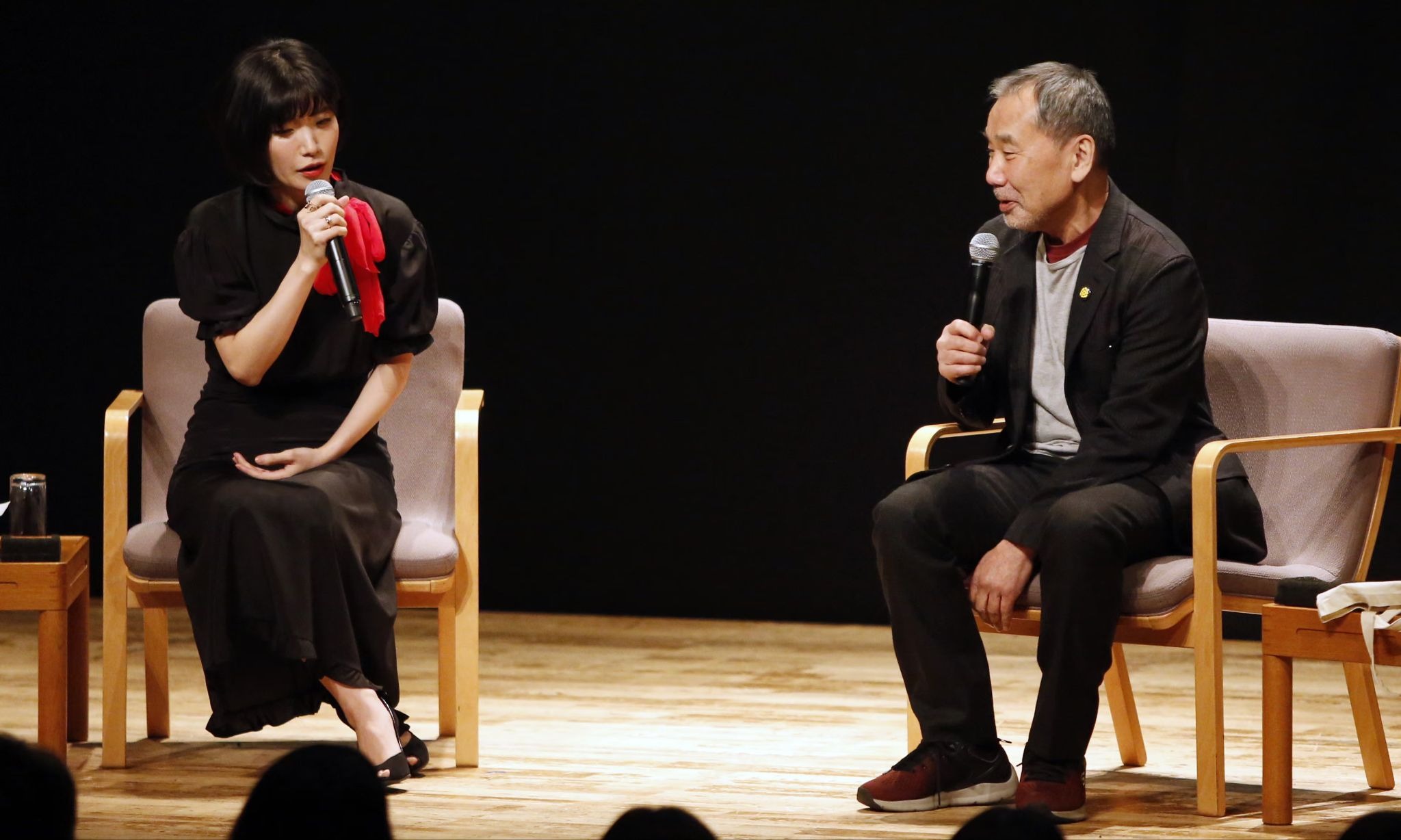
Image: The Guardian
In 2019, Kawakami published a piece on Literary Hub critiquing Murami’s depiction of women: “Oftentimes, sex functions as a skeleton key, allowing his protagonists access to other worlds. As these protagonists are overwhelmingly heterosexual and male, women must take on the role of sexual accomplice.”
At first glance, decentering heterosexual male desire could be a remedy to Murakami’s stale and problematic depictions. One of the two romantic relationships in Sputnik Sweetheart is a lesbian one, where Sumire’s lack of interest in sex, which initially is a positive marker of her difference (among with her interest in books and distaste for clothes), is eventually revealed to only apply to men. K, who desires Sumire, can only listen as Sumire talks about her desire for an older woman. However, K’s desire looms large in narrations of Sumire’s relationship, especially a sex scene, the wlw relationship a fantasy of lesbianism constructed by a heterosexual man.
With the rising global prominence of writers like Meiko Kawakami and Sayaka Murata, issues like female sexuality, reproduction, and labor are forefronted in mainstream literary consciousness. Women have won half of the last 34 Akutagawa Prizes, while writers like Yoko Ogawa — long admired for her psychologically precise and deeply interior fiction — have increasingly entered conversations around the Nobel Prize alongside Murakami. Now more than ever, women writers are able to write women characters born from actual lived experiences, instead of supplements for the male protagonist's journey.
Can Murakami write women characters beyond the limits of male desire? For Kawakami, the closest answer may lie in “Sleep”, Murakami’s short story about a woman in her thirties who develops severe insomnia and begins wandering the streets at night. Her body, no longer a conduit for male desire, becomes her own, allowing her to traverse Tokyo, to read Anna Karranina, to experience loneliness, not as fantasy or projection, but as something profoundly human.
LATEST