Wakaba Oto
Still Life With Teppei Kojima
Tattooed, fashion-minded, and unexpectedly traditional, Teppei Kojima is changing who bonsai is for.
The 43-year-old founder and CEO of TRADMAN'S BONSAI is dressed in his signature black glasses and well-tailored tapered trousers. Tattoos coil up from beneath his collar and sleeves in swirls of dark ink. He smiles, settles into his chair, and within minutes is talking about death.
"No matter how hard we try to care for them, we'll pass away before they do," he says. "But the bonsai will live on."
It’s a sentiment that surfaces often in the bonsai world. What makes Teppei Kojima unusual isn’t his reverence for the trees, but the path that brought him to them. Before bonsai, there was fashion. Before fashion, there was a childhood spent moving through circumstances that might have pushed someone else in a very different direction.
He grew up in Kashiwa, Chiba, in what he describes as a complicated family situation. For a stretch of his childhood, his parents weren't around, and he and his younger brother were placed in a children's home. The director there grew bonsai. Kojima was curious. "I asked him, 'What are you doing?' and he replied, 'Are you interested?'" That was the beginning, though it would take decades to become anything more than a memory.
What followed was a youth absorbed in street culture — music, fashion, tattoos — and an early adulthood marked by real hardship: losing his mother at 17, working his way up through a pachinko parlor, eventually landing in apparel as a buyer and traveling internationally. It was on one of those buying trips, at 31, that a foreign colleague showed him a bonsai. Unpruned, painted in colors he'd never seen on a tree. He decided that same night to start a business.
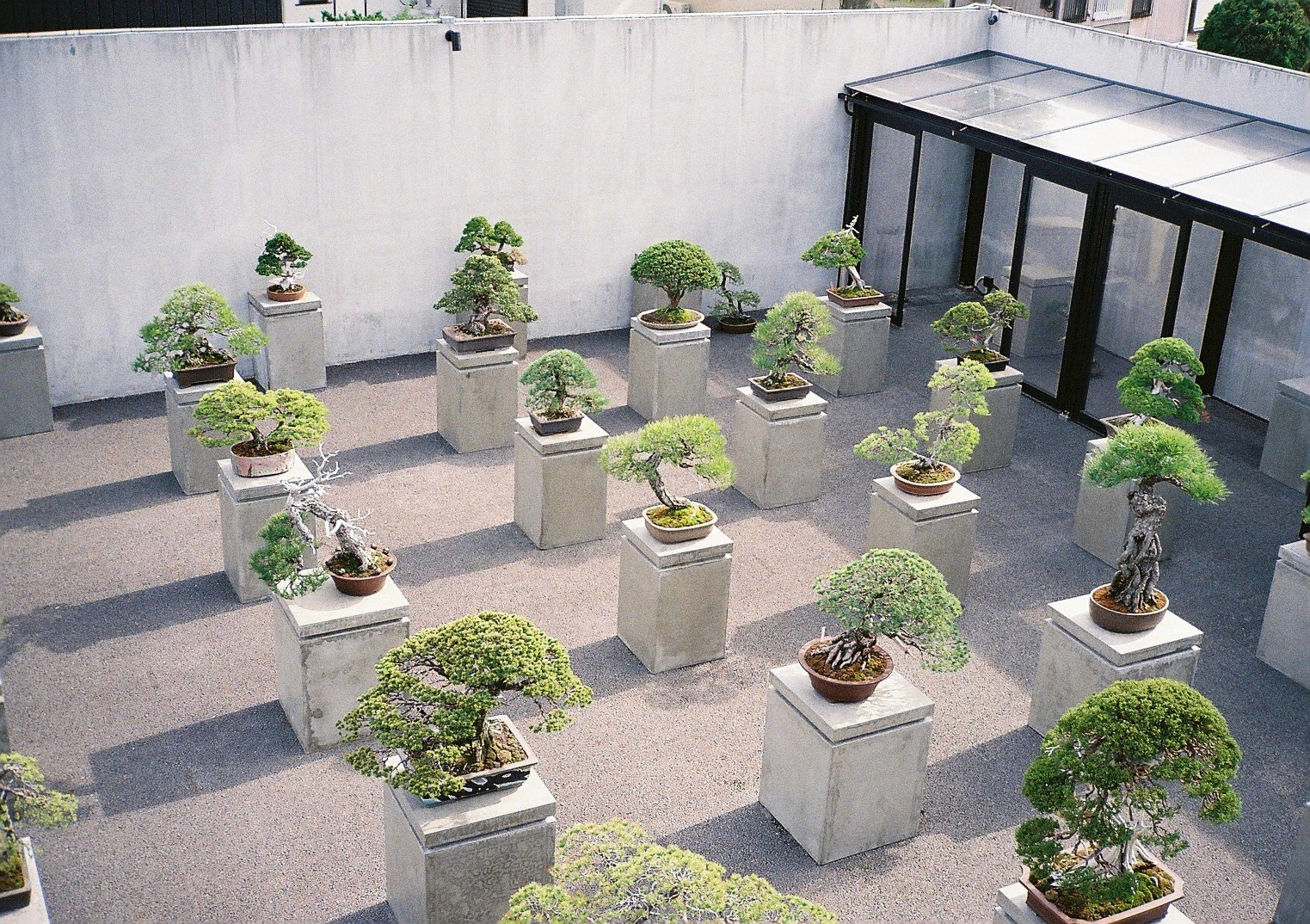
TRADMAN'S BONSAI launched in 2015 — the name short for "Traditional Man" — and has since collaborated with Dior, Cartier, Nike, A Bathing Ape, Levi's, and Jimmy Choo, among others. Kojima brought to bonsai the same instincts he'd developed as a buyer: an eye for presentation, an understanding of cultural context, and the conviction that the right framing changes everything. Where bonsai had long been the province of older collectors, practiced in private and revered in silence, he saw an art form with latent cultural force. "I've always said that originality comes from combining existing elements," he tells me. "I incorporated that idea into bonsai, along with the importance of life itself."
The world is becoming increasingly digital, he notes, but he doesn't think bonsai will disappear — because it can't be digitized in any meaningful sense. What he worries about is subtler. Bonsai is going global, and the appetite overseas is real, but the expertise and the trees themselves are leaving Japan with it. "If this continues," he says, "I'm genuinely worried that the culture of Japanese bonsai might disappear in 50 or 100 years." His project, then, holds a productive tension at its center: open the art form up, make it legible to younger generations and foreign audiences, while keeping its Japanese roots from being hollowed out. "We must protect Japan's trees, preserve Japanese bonsai, and promote our culture," he says. "I know there are some serious contradictions here. But I believe there is something valuable within all of this."
He holds that contradiction without apparent discomfort — which, given his biography, makes sense. Kojima has spent most of his life navigating between things that don't obviously belong together: street culture and ancient craft, commercial ambition and genuine reverence, a rough upbringing and an almost monastic sense of purpose. Bonsai, it turns out, accommodates all of it. "It's given me all sorts of insights," he says, "about life's triggers, ways of thinking, the essence of things. It's like a textbook for life."
LATEST