Wakaba Oto
FamilyMart’s Uniform Gets Less Uniform
Hiromichi Ochiai brings his Convenience Wear logic behind the register as Japan’s konbini giant loosens the visual rules of service work.
There are few garments less glamorous than a convenience-store uniform. It’s designed to disappear into the job, instantly recognizable from across a fluorescent aisle and ideally memorable only when something goes wrong. FamilyMart has spent the past five years making the clothes on one side of the register unexpectedly desirable; now that experiment has reached the people working behind it.
The chain’s new uniform comes from Hiromichi Ochiai, founder of FACETASM and creative director of Convenience Wear, FamilyMart’s in-house clothing label. When the line launched nationwide in 2021, konbini clothing still largely belonged to the minor emergencies of urban life: a clean T-shirt after missing the last train, dry socks after getting caught in the rain. Ochiai took those basics seriously, working with graphic designer Takahiro Yasuda and creative collective CEKAI on clothes and packaging that had to make sense immediately inside a store selling thousands of other things, to customers who might differ completely in age or nationality. As he later told Monocle, the challenge was designing something that could be understood by essentially anyone who walked through the door.
<Photo courtesy of FamilyMart>
The FamilyMart-striped crew socks became the sleeper hit of that logic, selling 1.4 million pairs in year one. The range grew into heavier tees, sweats, outerwear; by fiscal 2025 Convenience Wear was doing roughly ¥20 billion a year.
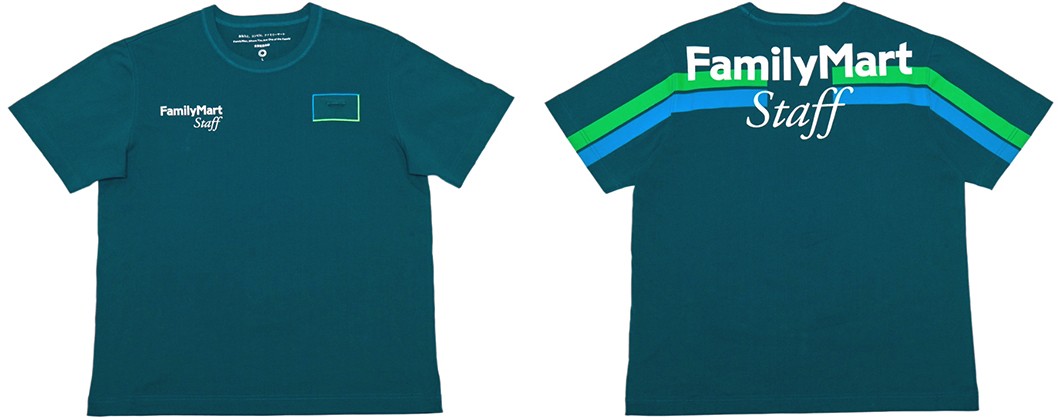
What Ochiai has done now is fold the staff themselves into that same design problem. The zip-up blouson FamilyMart staff have worn for a decade is gone, replaced by a thick, 100-percent cotton T-shirt adapted from Convenience Wear's own Outer T-Shirt, already a seven-million-seller in its civilian version. The staff edition comes in fourteen sizes, XS through 11L, treated for odor and bacteria, dyed a dark blue-green made specifically for the job. Staff had asked for something easier to move in and easier to coordinate with their own clothes, and FamilyMart says the result is the first T-shirt-style uniform in Japan’s convenience-store industry.
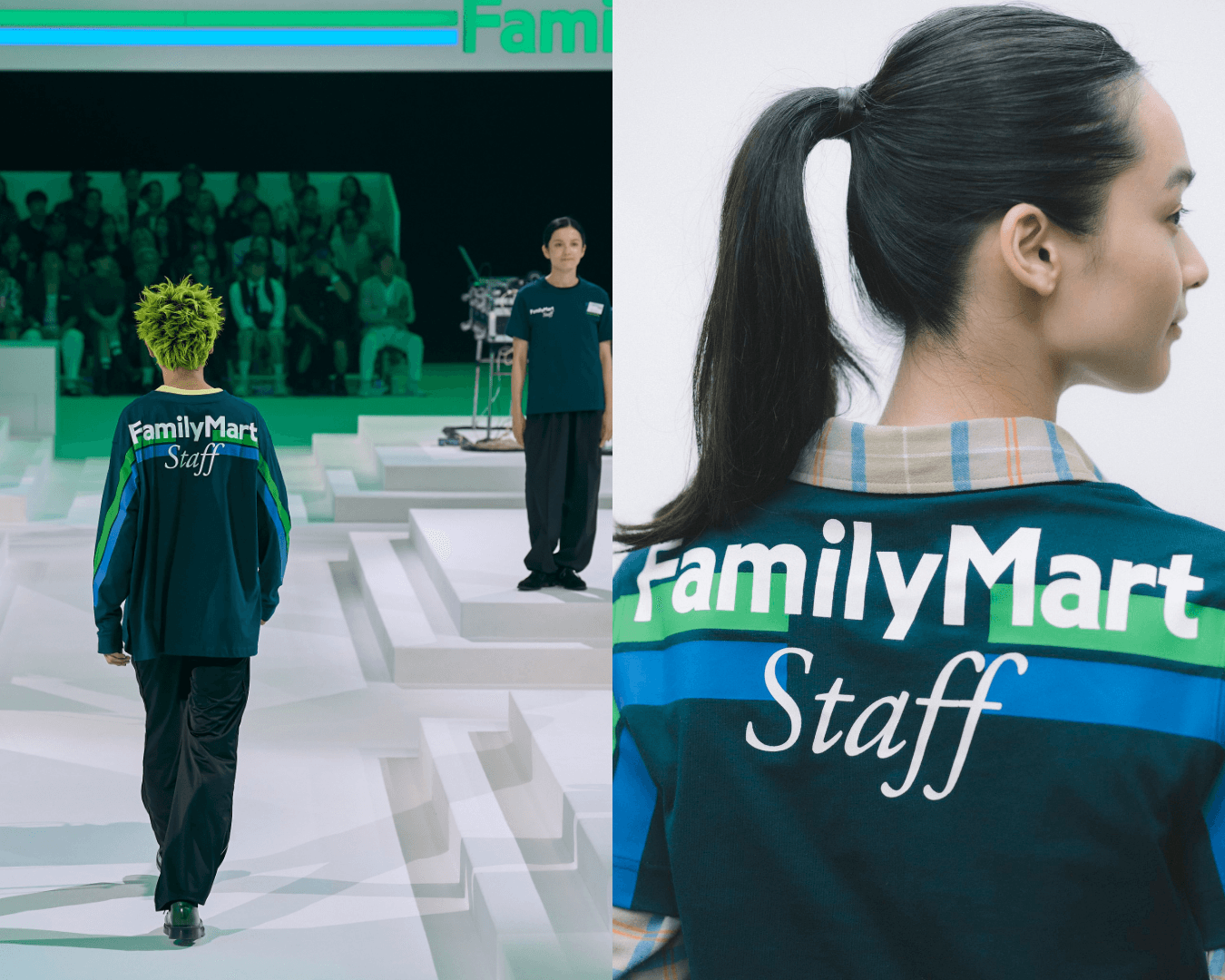
At Fami-FEST.2026 in August, the company treated those styling possibilities with considerably more ceremony than the average work shirt receives. Ryogoku Kokugikan was fitted with a 360-degree stage, where 26 people appeared in the new uniform before a larger cast of more than 100 took over the arena in Convenience Wear. Kotaro Yoshida wore his shirt loose over black sleeves; Rikako Yagi layered an XS over a white high-neck top. The event’s theme was “working at a convenience store,” with FamilyMart explicitly presenting different ways of wearing the same uniform as part of the show.
<Photos by FashionSnap & Shunya Arai>
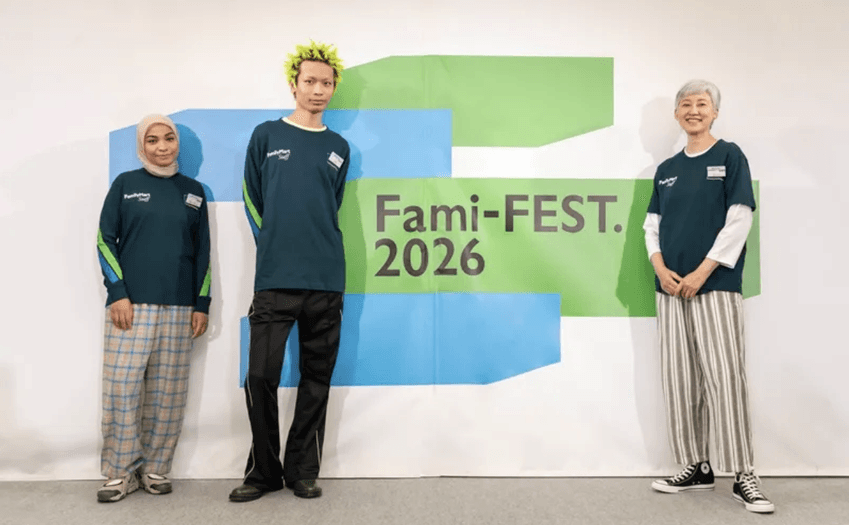
The styling was the show. The policy underneath it is the actual news. From September 1, FamilyMart introduced “Famima Code,” a new set of appearance standards across roughly 16,500 stores that removes restrictions on hair color, gives staff more latitude to wear their own layers and formally permits religious clothing including hijabs. Hijabs had already been accepted in individual cases, store operations chief Kenji Taniguchi told TV Asahi; the difference now is that the accommodation has been written into nationwide policy.
Foreign nationals now account for around 13 percent of FamilyMart’s roughly 200,000 store staff, and the company has been straightforward about wanting the new rules to help it recruit more people as franchisees struggle with staffing. Across Japanese retail, employers have begun reconsidering grooming standards that once regulated details as specific as hair shade, partly because younger workers increasingly dislike them and partly because companies have less room to turn applicants away.
The hijab provision has produced some of the ugliest reactions to the new policy. Complaints on Japanese social media have often been framed around hygiene, even though FamilyMart’s cleanliness and safety standards remain unchanged; the company has had to clarify that religious dress does not exempt anyone from the rules applied to everybody else. A woman covering her hair behind a convenience-store register generating this much anxiety is precisely the reason the sight needs to become ordinary as fast as possible.
<Photo courtesy of FamilyMart>
Ochiai once described the convenience store as capable of reaching people whom fashion normally separates into different audiences. His new uniform asks relatively little of them once they put it on. Across 16,500 stores, the dark blue-green shirt remains immediately recognizable; everything around it has become harder to standardize.
LATEST