Wakaba Oto
Tokyo's Disappearing Love Hotels and the Death of Camp
When did we stop building things that were willing to look ridiculous?
There's a love hotel in Aomori called Napoleon. From the road, it looks like a row of little gingerbread chateaux — a French royal court rendered at roadside scale, in a part of Japan as far from Versailles as it is possible to get. There are about a dozen rooms, and each one has a name. The list begins with kings and ends, correctly, with love: Louis XIII, Napoléon, Emmanuelle, Élysée, Madonna, Venus, Amour. Inside, the ceilings are mirrored. The beds rotate. One is shaped like a giant clamshell.
I have never stayed there. I looked it up on a Tuesday afternoon, from a desk in New York, and felt something that took me a moment to identify as grief.
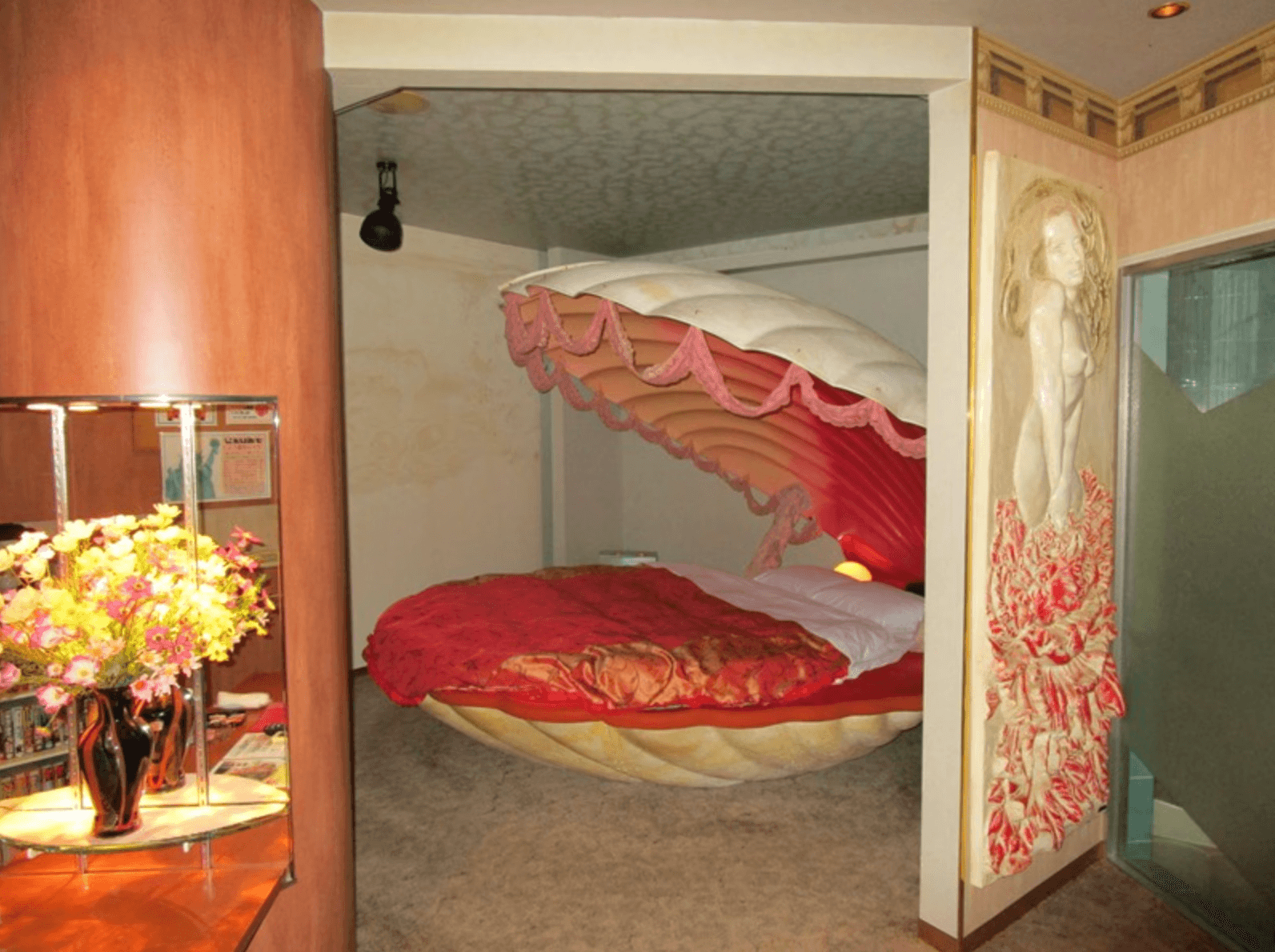
<Image: Room Emmanuel in Hotel Napoleon. Courtesy of napoleon1.jp>
Before he designed rotating beds, designer Ami Ishin designed kindergartens. "When I put an animal on the door handle of a nursery toilet, the children leapt for joy,” he recalls. The principle transferred directly: make a room so intensely not-ordinary that whoever enters it cannot help but feel something. A place, as he put it, where adults feel excited.
His casino-themed room took its cues from Las Vegas — roulette wheel on the ceiling, cards on the walls — and looks, in photographs, like something you'd encounter on the Strip if the Strip had been designed by someone who’d never actually been to the Strip.
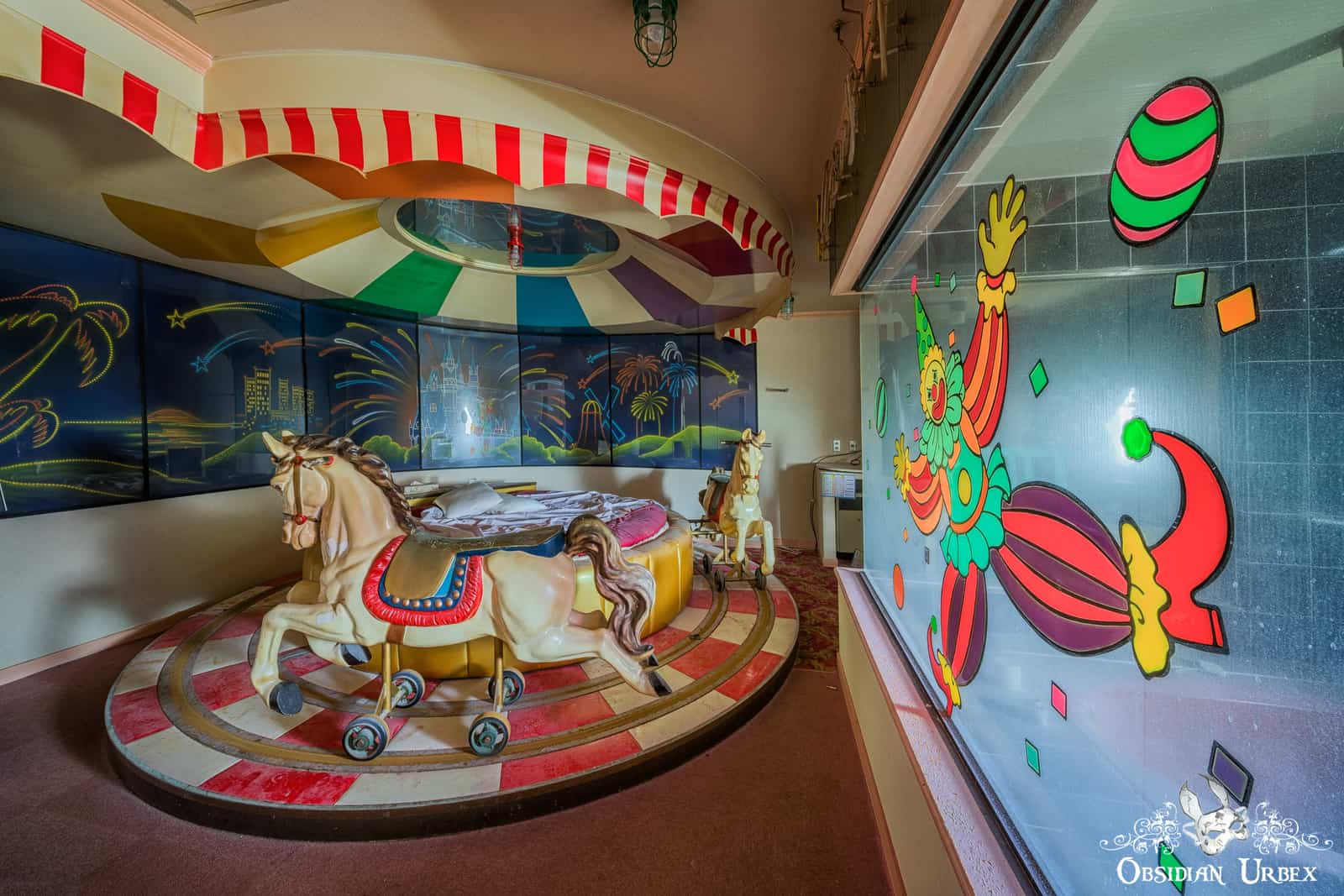
At their Showa peak, roughly 1965 to 1985, love hotels were gloriously gaudy. In Kawasaki, the Geihinkan still stands, just barely, with suites designed to resemble everything from a Chinese courtesan's love nest to a Rococo maisonette (the Romanesque tubs, it is reported, are awfully slippery). One now-abandoned hotel in Mie had twenty rooms with a pictorial menu so you could choose before you committed: the airplane cockpit with orange runway lights; the Rolls-Royce room where the bed was a canary-yellow car; the S&M room with a bondage apparatus decorated with a large red Soviet star.
The genre peaked in 1973 with the Meguro Emperor: a hotel modeled on Cinderella's castle, in real marble, amethyst, and onyx, at a total cost of 650 million yen. Newsweek covered the opening.
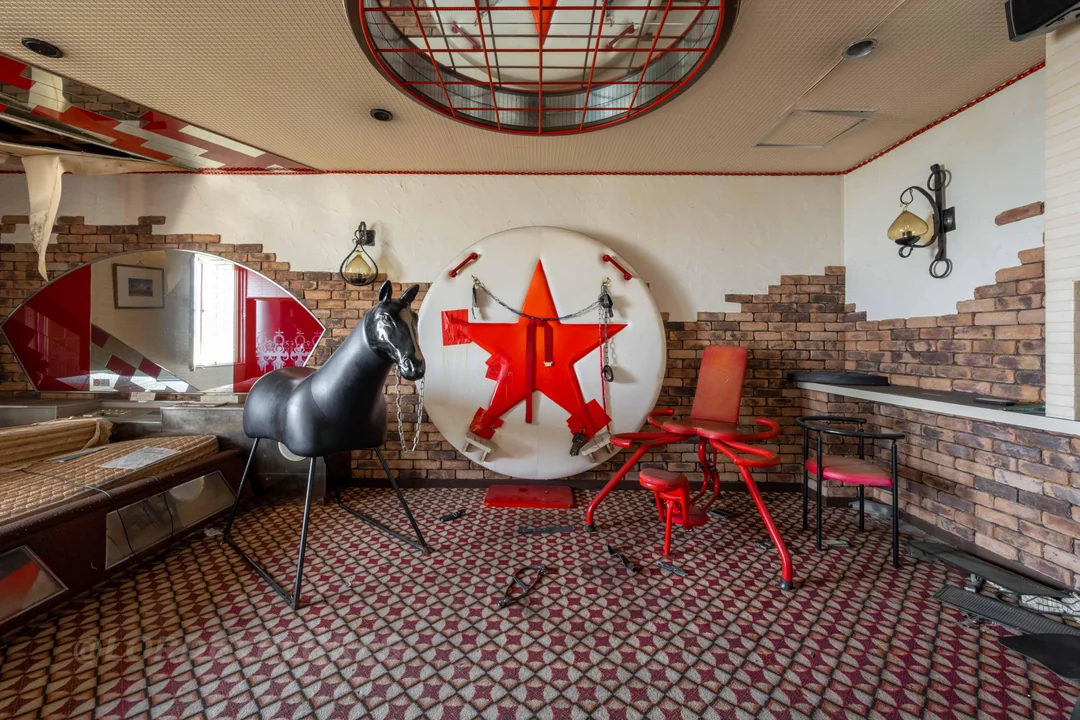
<Image: An S&M-themed room decorated with a large red Soviet star. Courtesy of LordExplores on Reddit>
What the love hotel offered was never sex, exactly. Sex was theoretically available at home, assuming you could ignore the paper-thin walls and the family down the hall. In central Tokyo alone there were around 2700 tsurekomi inns — the cramped precursors to love hotels — by 1961, a number that reflects not prurience so much as arithmetic; Japanese homes of the period had no private room at all. Married couples used the tsurekomi inns for the same reason anyone would: there was simply nowhere else to go.
What the full-scale love hotel offered was something different from a merely private room. It offered the other thing — the unreality, the room that belonged to no recognizable world. The chance to step, briefly, into a fantasy that had been designed with tremendous sincerity.
The purest camp, Susan Sontag observed, is bad taste pursued with total conviction; a genuine belief in something extravagant. The Showa love hotel fits the definition almost too perfectly. Its extravagance was earnest. It wanted, with its whole heart, to astonish you.
Ami Ishin drew a straight line from the joy of a child reaching for an animal-shaped handle to the joy of an adult stepping into a room where the bed slowly, majestically rotated. Both are acts of pure, unjustified wonder-creation. That is camp. That, as far as I can tell, is what is disappearing.
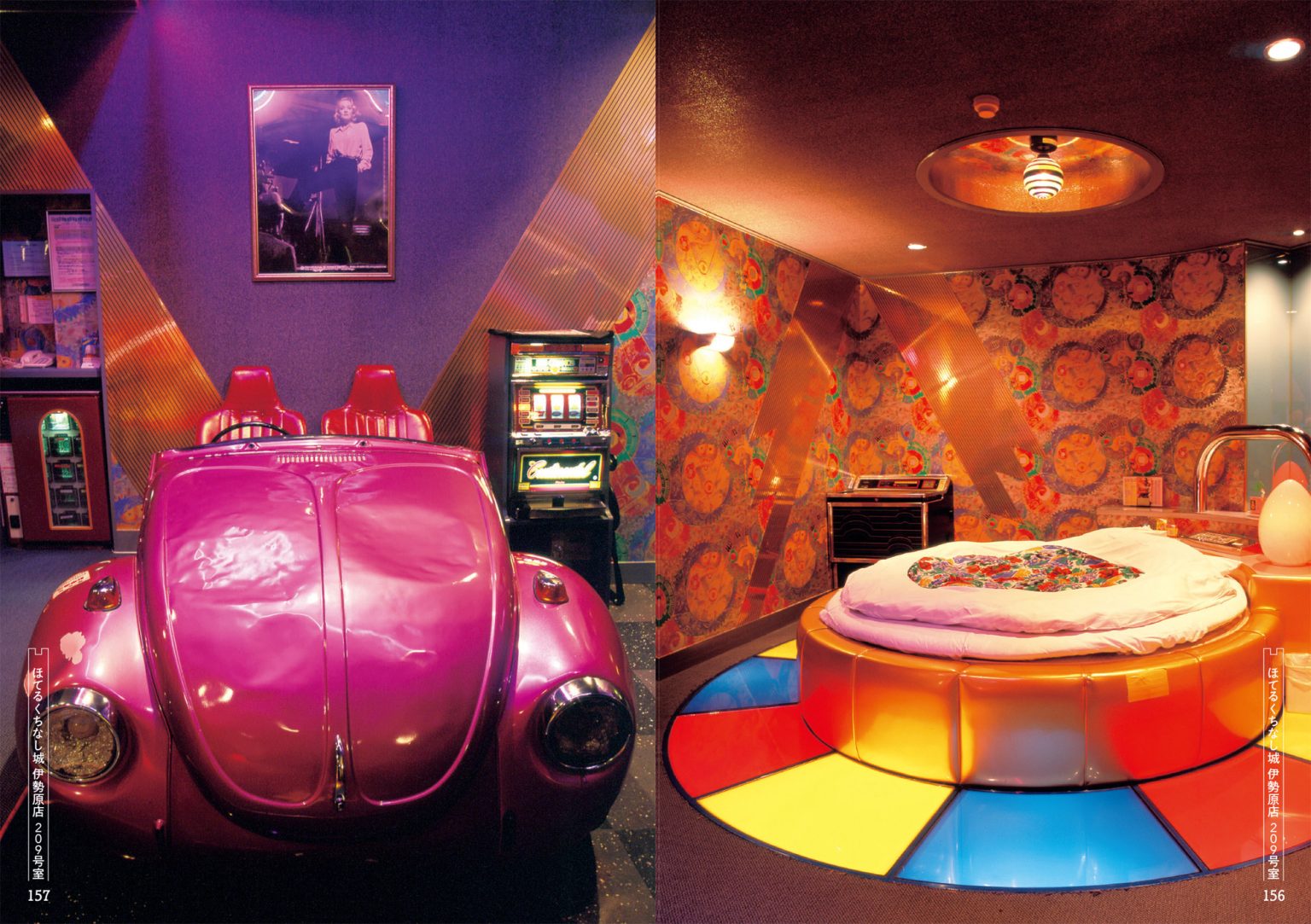
<Image: A Showa love hotel photographed by Kyoichi Tsuzuki for Love Hotels. Courtesy of Kyoichi Tsuzuki and Baron Books>
In 1985, Japan revised its entertainment business laws and formally separated love hotels from ordinary hotels. The law effectively defined a love hotel through specific design features: rotating beds, mirrored ceilings, adult vending machines, transparent bathroom glass. Hotels that fell under the classification faced stricter regulations, including zoning restrictions and increased police oversight.
Many owners responded by stripping out the very features that had once defined the genre. Rotating beds disappeared. Mirrors came down. Hotels remodeled themselves into cleaner, more conventional couples hotels that resembled ordinary business hotels from the outside and, increasingly, from the inside too.
The Meguro Emperor’s rotating beds stopped turning the following year. Today, the hotel offers saunas and Simmons mattresses. The amethyst is gone.
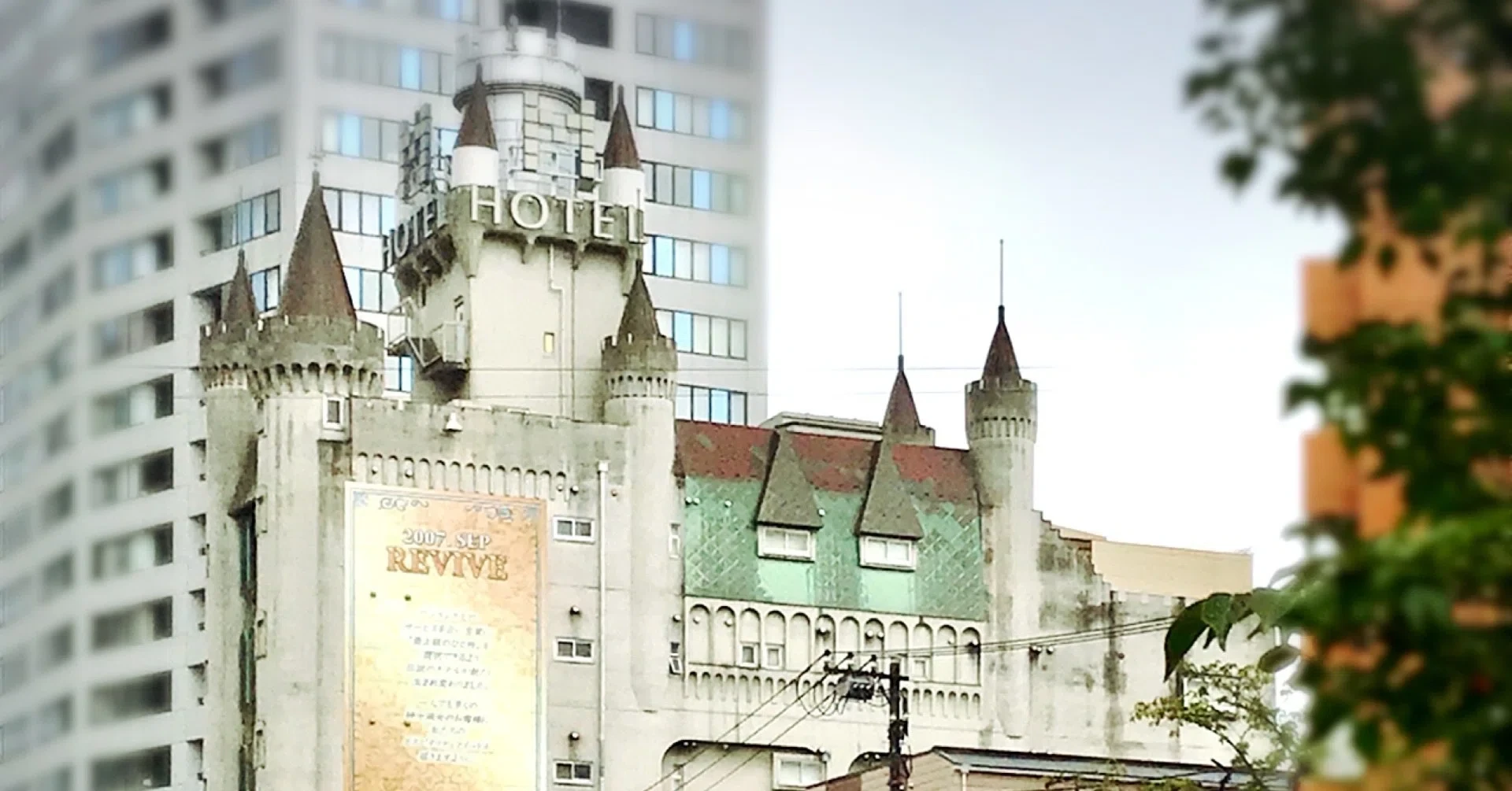
<Image: The Meguro Emperor>
Photographer Kyoichi Tsuzuki, whose photobook Love Hotels was reissued by Baron Books earlier this year, puts the closure rate at nearly 100 hotels per year. A 2024 survey found 64 percent of married respondents described themselves as sexless.
The fantasy, it seems, has nowhere left to go — which is strange, given that Japan had — has, still, really — one of the most elaborate erotic imaginations on earth. The shunga woodblock prints of the Edo period depicted couples, threesomes, and women in explicit congress with octopi. Hokusai, the man who painted The Great Wave, spent considerable energy on exactly this. The Meiji Restoration declared the whole tradition obscene and drove it underground. What survived afterwards wasn't repression, exactly; it was compartmentalization: desire pushed inward, developing in the dark into something of unfathomable specificity.
You can trace that logic straight through modern Japanese internet culture. 2chan. Comiket. Micropically niche erotic subgenres (tentacle porn). Japanese culture became extraordinarily good at creating sealed-off zones where private desire could exist without colliding with public identity.
The love hotel was the physical version of that system. The buildings said, from a block away, what nobody said at dinner: here, you are allowed to want things. The love hotel was where fantasy acquired walls, plumbing, and room service.
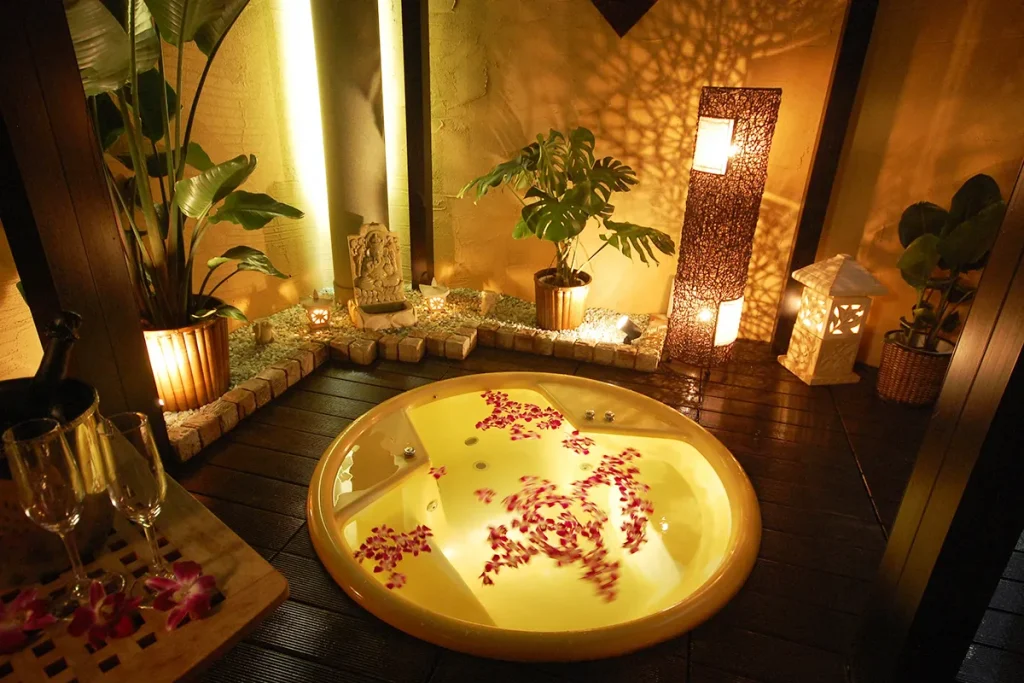
<Image: A room at the modern Bali-An hotel. Courtesy of balian.jp>
The modern version is, by most measures, quite lovely. Bookable by app, sometimes listed alongside business hotels on Rakuten Travel. You already know this room, because you’ve been in it everywhere. It’s the coffee shop in Seoul that’s indistinguishable from the coffee shop in Lisbon that’s indistinguishable from the coffee shop in Mexico City, except that instead of third-wave pour-overs and reclaimed wood, it’s white walls and a rainfall shower and a faux-concrete sink and LED strip lights glowing pink, purple, occasionally a brave red.
Kyle Chayka calls this "AirSpace": the frictionless global aesthetic optimized for legibility, which is another way of saying it has nowhere left to be from. The logic is familiar. Why build ten wildly different rooms when one tasteful room can be photographed, marketed, and reproduced indefinitely? Why cater to a fantasy when you can appeal to everyone?
This is not to say that weird love hotels no longer exist, at least not completely. There are still water slide rooms. There is also Machida’s Candyland-themed Sweets Hotel with the vaguely unsettling chocolate bar mascot. But these surviving fantasy rooms increasingly feel self-conscious: they know they are weird, they know they will be posted on Instagram; they know they will be vlogged (Come with me to the craziest love hotel in Tokyo!). It’s the difference between building a rotating clamshell bed because somebody genuinely thought it would be magnificent and building something because it will look good on Instagram. The water-slide room is no longer competing with the room next door; it’s competing for thirty seconds in somebody's reel.
There is still porn on the television, condoms by the headboard. The hotel still knows what it's for. It has style, but style is not the same as nerve, and it is most definitely not the same as camp. Camp requires belief. The new love hotel doesn't believe in anything except its own marketability.
I have stayed in these newer hotels. One had enough bath salts and shampoos to stock a small pharmacy. Another looked like a resort in Bali. They were comfortable, convenient, excellent, even.
But I cannot imagine feeling grief if they disappeared.
What feels distant now, perhaps, is not merely the aesthetic excess, but the willingness to risk embarrassment in pursuit of wonder. Someone, somewhere, believed in an idea hard enough to build an entire room around it.
Napoleon still turns. So does the bed at Hotel AI in Numazu, open since 1978, which rotates and rises two meters into the air. But hotel supervisor Kitagawa Kazue recently told Nabe Ayumi — a photographer who’s spent years documenting these rooms and owns a rotating bed herself — that the craftsmen who repair such mechanisms are growing old, and no one is learning to replace them.
"When they're gone," he says, "I don't know what we'll do.”
LATEST