Alyssa Samuel
Why Tokyo Doesn't Sleep After the Last Train
After the last service, another city opens. What fills the gap says more about Japan's working life than its nightlife.
The first thing you notice is the quiet, and then you realize it isn't quiet at all. Around 1 a.m., after the last Yamanote train, Shinjuku Station exhales. The gates go still. The overhead announcements stop. What's left is the hum of fluorescent light, the distant clatter of a konbini restocking fridge shelves, and men in suits — singly, in pairs — standing somewhere they're not quite sure what to do with themselves.
For tourists, the scene reads as nightlife. For anyone who has lived here, it reads as something else: the hours between the last train and the first have become their own distinct interval, shaped less by the desire to stay out than by the structures that make going home difficult.
At the center of this culture is Japan's relationship with alcohol— specifically with nomikai, the after-work drinking gathering that has long acted as an extension of professional life. Employees gather with coworkers and supervisors at izakayas, sharing drinks and conversation in an environment where workplace hierarchies are meant to loosen. Officially, attendance is voluntary. In practice, many workers understand that skipping has a cost.Long hours, lengthy commutes, and a strong emphasis on group harmony have shaped generations of workers. Drinking provides a socially accepted outlet: a way to vent, to bond, to briefly escape the pressures of the office. The line between work life and personal life blurs accordingly, and often doesn't reassert itself until well after midnight.
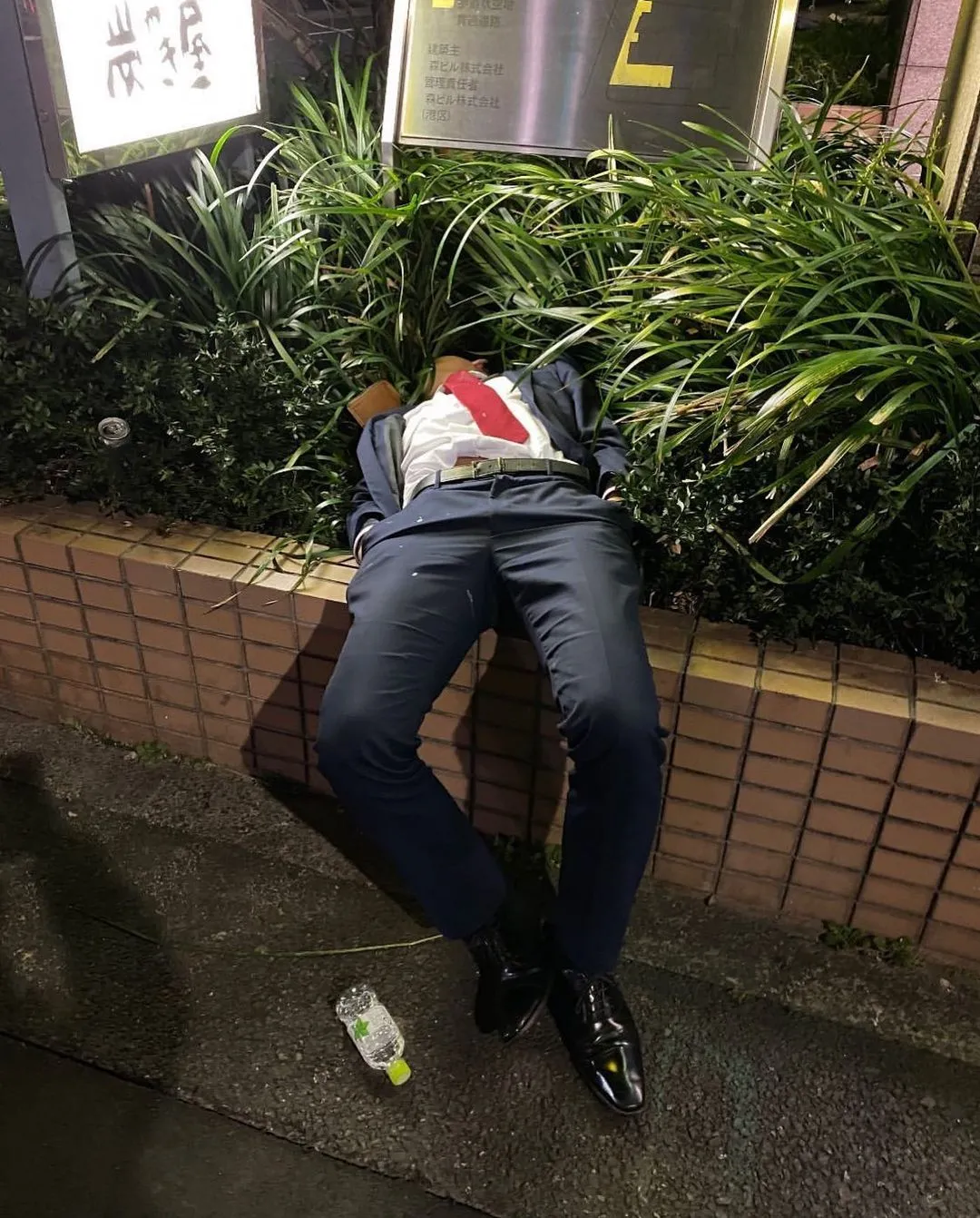
The passed-out salaryman has his own corner of the internet (see: @shibuyameltdown). Abroad, it reads as a curiosity. Here it reads as a Tuesday. The suit is still on. The briefcase is upright. He's done everything right — worked late, drank with colleagues, honored the obligation — and this is just where that ends up.
Alcohol also does another kind of workDespite living in one of the world's largest cities, many people experience genuine isolation. Long working hours can make it difficult to maintain friendships, while social norms surrounding privacy and emotional restraint often limit opportunities for deeper personal connection. In this environment, bars and izakayas become more than places to drink — they become places where conversations happen that won't happen anywhere else.. For some, a late-night gathering is less about alcohol itself and more about the sense of belonging it provides.
The city that develops around all of this is the proof. Restaurants serving until 5 a.m., manga cafes renting sleeping pods by the hour, the same convenience store clerk watching the same regulars come in at 2 a.m. for years — none of it is accidental. It is what a city looks like when a significant portion of its working population routinely cannot get home before the trains stop.
But that culture may be shifting. Younger generations are drinking less, and surveys consistently show that Gen Z workers are less willing to treat nomikai as a professional obligation. Attitudes toward work-life balance are shifting as well. Many young workers simply want their evenings back.
Whether this changes the hours between trains or just repopulates them is harder to say. Japan has tried structural reforms to working culture before — legally mandated hour caps, encouraged leave — without dramatically shifting what actually happens. The benches in Shinjuku may thin out. Or the people on them may just be younger, and drinking less, and still not quite ready to go home.
LATEST